.png?width=765&height=430&name=7%20(1).png)
.png?width=660&height=543&name=Frame%201984077310%20(1).png)
 Initial HubSpot setup
.png?width=500&height=500&name=36%20(1).png)
The launchpad website: how to launch a high-performing site in 12 weeks
The core failure isn't design quality or developer skill. It's the model itself.
Traditional web design front-loads all decisions before you have any data. You're making hundreds of choices about layout, copy, navigation, and user flow based on assumptions, stakeholder opinions, and competitor benchmarking. None of those inputs tell you what your specific audience actually responds to. You find out after launch, when it's too late to change course without spending more money.
We've seen this pattern in over 100 builds. Three problems show up almost every time:
Messaging gets neglected. Teams spend 80% or more of the budget on visual design and development. Messaging and buyer journey work might get a few hours. But 80% of a website's performance comes from the words on the page and how well they guide someone from "I have a problem" to "this company can solve it." You can have the most beautiful site in your industry and still underperform a plain-looking competitor whose copy nails the buyer's actual concerns.
Perfectionism delays launch. When the entire project hinges on one big reveal, every detail feels high-stakes. Stakeholders debate button colors while the current site bleeds conversions. The real threshold should be simple: is the new messaging and buyer journey better than what you have today? If yes, launch it. Everything else can be refined once real users are interacting with it.
There's no plan for what happens after launch. Traditional projects treat launch day as the finish line. The agency delivers, the invoice gets paid, and the site enters maintenance mode. Six months later, the team has questions about performance but no framework for answering them. The site drifts until someone decides it's time for another redesign.
The three phases of growth-driven design
GDD runs in three phases: strategy, launchpad, and continuous improvement. Each one has a clear purpose and a specific timeframe. The whole approach assumes you'll keep learning after launch, so phase one and two are built to move fast.
Phase 1: Strategy (weeks 1 to 4)
Strategy is where you figure out what your website actually needs to accomplish and for whom. This isn't a kickoff meeting with a mood board. It's a focused sprint on messaging, buyer journey, and page architecture.
The work includes competitive analysis, customer research, and mapping out a 2-to-4-step buyer journey for each core solution you offer. You're answering five questions about every key page:
- Why should the buyer listen to you at all?
- Why should they change from what they're doing now?
- How should they change?
- How does your solution make that change easier?
- Where's the proof?
By the end of this phase, you know exactly which 3 to 8 pages actually matter, what they need to say, and how they connect to each other. Everything else is secondary.
We run this as a messaging sprint using our MessageRocket tool, which structures the research and output into a format that feeds directly into design. Packages range from $9K to $12K depending on scope.
Phase 2: Launchpad (weeks 5 to 8)
The launchpad is your initial site build, and the name is intentional. It's a launch pad, not the final destination. You're building the 3 to 8 key pages identified in strategy, with strong messaging and a clear buyer journey, and getting them live.
This is not about launching an ugly or half-finished site. Launchpad pages should look good and function well. What you're pushing to phase three is the ultra-custom, premium design components that take weeks to build and have minimal impact on conversion. A well-structured page with solid copy and clean design will outperform a visually extravagant page with weak messaging every time.
The launchpad build typically takes four weeks for design and four weeks for development. On our projects, we handle design in Figma and build on HubSpot CMS. The total timeline from strategy kickoff to launch is about 12 weeks, one quarter.
Pricing for the full launchpad build (strategy through launch) ranges from $30K to $70K+ depending on the number of pages and level of custom functionality.
.png?width=1390&height=754&name=Growth%20Playbook%20Image%20(1).png)
Phase 3: Continuous improvement (ongoing)
Once the launchpad site is live, you have real users generating real data. Every month, you use that data to make decisions based on evidence instead of opinions.
Each month, you identify the highest-trafficked pages with the worst metrics (high bounce rates, high exit rates, low conversion rates) and prioritize improvements using the ICE method:
|
Factor |
Question |
|---|---|
|
Impact |
If this works, how much will it move the metric? |
|
Confidence |
How sure are we this will work based on data and experience? |
|
Ease |
How quickly and cheaply can we implement and test this? |
The improvements might be headline changes, form placement adjustments, CTA copy rewrites, page layout restructuring, or new content sections. Each one gets tested, measured, and either kept or rolled back based on statistical significance. No gut feelings. No "the CEO's spouse didn't like the color."
This phase is what keeps a GDD site from aging. Traditional sites start declining the day after launch because nothing changes. A GDD site gets better every month because you're feeding it data.
We offer this as a fractional GDD service at roughly $5,000 per month.
What kind of results does GDD actually produce?
The numbers vary by starting point, but the math is straightforward. If you cut the exit rate on your key pages by 50%, twice as many visitors reach your conversion pages. If you then double the conversion rate on those pages, you've potentially increased total conversions by 4x. We typically see 100% to 300% improvement in conversion rates across the sites we manage with ongoing GDD.
Those gains compound over time. A site that improves by 5% to 10% per month on its key metrics will look unrecognizable (performance-wise) a year later, even if the visual design hasn't changed much.
The less obvious benefit is what you stop spending. Teams running GDD don't do ground-up redesigns every two to three years. That $50K to $100K+ cycle disappears. You invest a fraction of that monthly and get better results because you're building on data, not starting from scratch.
As Kevin Barber puts it: "Having to rebuild your website is simply a signal that you have not been paying attention to your core messaging or your metrics."
Who is growth-driven design for?
GDD works best for companies that meet a few criteria:
You have enough traffic to generate meaningful data. If your site gets 50 visits a month, you won't reach statistical significance on any test. GDD's continuous improvement phase relies on having enough data to make confident decisions. B2B companies with at least a few thousand monthly sessions are in the right range.
You sell something with a considered purchase cycle. If your buyer needs to research, compare, and evaluate before committing, your website's messaging and journey matter enormously. SaaS companies, professional services firms, and B2B companies with deal sizes above $5K tend to get the most from GDD because small conversion improvements translate to significant revenue.
You're willing to treat your website as an ongoing program, not a project. The launchpad gets you live. The value comes from what happens after. Teams that launch a GDD site and then stop optimizing are leaving most of the returns on the table.
You're tired of the redesign cycle. If you've rebuilt your website two or three times in the past decade and performance always peaks at launch and declines from there, the pattern isn't going to change by doing the same thing with a different agency. GDD is a different model entirely.
GDD and HubSpot: why we build on HubSpot CMS
We've been a HubSpot partner since 2013, and we build almost all of our GDD projects on HubSpot CMS. The reason is practical: GDD requires your marketing platform, CMS, CRM, and analytics to share the same data. HubSpot puts all of that in one system.
When you're running monthly optimization sprints, you need to see which pages have the highest exit rates, which CTAs convert, and which contacts from those conversions actually became customers. On HubSpot, that data is already connected. You don't need to stitch together Google Analytics, a separate CRM, a third-party heatmap tool, and a standalone A/B testing platform. The feedback loop is built in.
We've also developed our own tools to speed up HubSpot builds. Sprocket Rocket is a modular codebase that gives us pre-built, tested components so we're not coding basic page elements from scratch on every project. Schema Rocket handles structured data markup so your site is readable by search engines and AI systems. Both reduce build time and improve baseline performance out of the gate.
If you're evaluating CMS platforms, HubSpot also makes it easy to start small and scale. You can begin with starter-tier tools and move to professional or enterprise as your needs grow. The HubSpot for Startups program offers discounted pricing for qualifying companies.
How GDD compares to traditional web design
|
Traditional web design |
Growth-driven design |
|
|---|---|---|
|
Timeline |
3 to 6+ months before launch |
12 weeks to launchpad |
|
Budget model |
One large upfront investment |
Launchpad investment plus ongoing monthly |
|
Launch scope |
Full site, all pages |
3 to 8 key pages focused on buyer journey |
|
Design decisions |
Based on assumptions and stakeholder preferences |
Based on data from real user behavior |
|
Post-launch plan |
Maintenance mode (fix bugs, update content) |
Monthly optimization sprints with testing |
|
Redesign cycle |
Every 2 to 3 years |
Continuous, no full rebuilds needed |
|
Messaging investment |
Often minimal (a few hours) |
Core focus of strategy phase |
|
Typical lifespan |
2 to 3 years before declining performance |
7+ years with ongoing improvement |
How to get started with growth-driven design
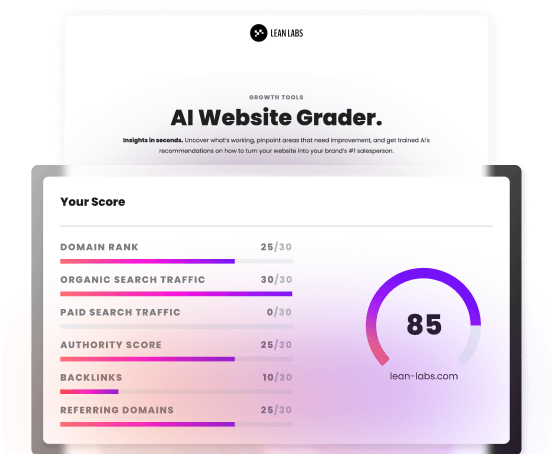
If you want to explore whether GDD makes sense for your situation, start with an honest assessment of your current site. Run your metrics through GrowthGrader.com to see where you stand on the benchmarks that actually matter: bounce rate, exit rate, conversion rate, and page-level performance.
From there, the first real step is messaging. Before you touch a single pixel of design, you need to know whether your current site is saying the right things to the right people in the right order. That's what our strategy and messaging process is built to figure out.
If you want to see how we approach full website builds using GDD, check out our approach page or start a conversation directly. Our guarantee is simple: if you're not happy within the first three weeks, you get a full refund. We call it "No Yay, No Pay" because the only people taking risks on a GDD engagement should be us.
Frequently asked questions about growth-driven design
How much does growth-driven design cost? A full GDD engagement (strategy, launchpad design, and development) typically runs $30K to $70K+ depending on scope. The strategy and messaging phase alone ranges from $9K to $12K. Ongoing optimization after launch runs roughly $5,000 per month.
How long does it take to launch a GDD website? About 12 weeks from kickoff to launch. That breaks down into roughly four weeks of strategy and messaging, four weeks of design, and four weeks of development. Every site we build launches within one quarter.
Can I do GDD on my existing site or do I need a full rebuild? You can apply GDD principles to an existing site by starting with the continuous improvement phase. Assess your key pages, identify where metrics are weakest, and begin testing. That said, if your current messaging and buyer journey need a complete rethink, starting with a proper strategy phase and launchpad will give you a stronger foundation.
What's the difference between GDD and agile web development? Agile is a project management methodology. GDD is a website strategy that happens to use iterative principles. The key difference is that GDD is specifically designed around conversion data and buyer journey optimization, not just iterative delivery. You could run an agile web project and still launch a site that nobody optimizes afterward.
Is GDD only for HubSpot websites? No. The methodology works on any CMS. We build on HubSpot because it provides the integrated analytics and CRM data that GDD's optimization phase depends on, but the core principles (launch focused, improve with data, never stop optimizing) apply regardless of platform.
What if I don't have enough traffic for testing? If your site gets fewer than a few thousand visits per month, you likely won't reach statistical significance on A/B tests quickly. In that case, GDD shifts toward qualitative research (user interviews, session recordings, heatmaps) and best-practice improvements rather than formal split testing. As traffic grows, you transition into data-driven testing.