.png?width=660&height=543&name=Frame%201984077310%20(1).png)
 Initial HubSpot setup
.png?width=500&height=500&name=7%20(1).png)
What is growth-driven design? The complete guide to smarter website builds
At our shop, a GDD engagement follows a 12-week launch cycle: 4 weeks on messaging and strategy, 4 weeks on design, and 4 weeks on development. After launch, the site enters a continuous improvement phase where we use bounce rates, exit rates, and conversion data to prioritize what gets built or changed next. Clients running this model with us have stayed on the same website for 7+ years, because the site keeps getting better instead of going stale.
What is traditional web design?
Traditional web design (sometimes called the waterfall model) treats a website as a one-time project with a defined start and end date. You brief the agency, they design mockups, you go through rounds of revisions, they build it, you launch it, and the project closes.
The timeline is usually quoted at 3 months but regularly stretches to 4 or 5. The budget is fixed upfront, and the vast majority of it goes toward visual design. Strategy and messaging might get a few hours of attention. The site launches, the team moves on, and nobody touches it again until the next redesign cycle, typically 2 to 3 years later.
How do the two approaches compare?
|
Traditional web design |
Growth-driven design |
|
|---|---|---|
|
Timeline to launch |
3-5 months (often delayed) |
12 weeks (4 strategy + 4 design + 4 dev) |
|
Budget allocation |
Heavy on design, light on strategy |
Balanced across messaging, design, and dev |
|
Messaging investment |
A few hours, sometimes less |
4 full weeks of research and positioning |
|
Pages at launch |
Full site, every page at once |
3-8 key pages that drive results |
|
Post-launch activity |
Site goes stagnant |
Monthly data-driven improvements |
|
Decision-making |
Opinions and stakeholder preferences |
Bounce rate, exit rate, conversion data |
|
Typical lifespan |
2-3 years before next redesign |
7+ years with continuous improvement |
|
Cost structure |
$30K-$70K+ one-time project |
$30K-$70K+ launch + ~$5,000/month ongoing |
|
Risk model |
All budget committed upfront |
Phased investment based on results |
Why does traditional web design keep failing?
Too much budget on design, not enough on messaging
80% of a website's performance comes from messaging and the buyer journey. The remaining 20% comes from custom design. Traditional projects flip that ratio. Agencies pour most of the budget into visual design while giving messaging a few hours of workshopping at best.
The result is a site that looks different but says the same things. You launch a prettier version of the same underperforming copy. Traffic patterns stay flat because the words on the page, the ones actually doing the selling, never got the attention they needed.
.png?width=1390&height=754&name=Growth%20Playbook%20Image%20(1).png)

Perfectionism delays launch by months
A 3-month traditional project almost always becomes 4 to 5 months. Stakeholder reviews stack up. Someone wants to tweak a color palette. A VP weighs in late and wants to rethink the homepage layout. Every round of revisions pushes the timeline.
While the team debates font choices and hero image treatments, the current site keeps underperforming. Every week of delay is a week of lost data on what your audience actually responds to. You cannot optimize a site that does not exist yet.
No political will to fix it after launch
After a traditional redesign wraps, the team is exhausted. The agency relationship closes out. Nobody has budget, energy, or mandate to keep working on the site.
So the website sits. Pages that underperform stay underperforming. Copy that misses the mark stays live. The team knows something is off but there is no mechanism to address it. The site slowly drifts further from what the market actually needs until someone finally says, "We need a redesign," and the whole cycle starts again.
It reinforces the idea that marketing is a cost center
When you spend $50K+ on a website and can't point to measurable improvement in leads or revenue, the executive team draws a predictable conclusion: the website is an expense, not an investment. That makes the next budget conversation harder. It makes it harder to get buy-in for ongoing optimization. It creates a self-fulfilling cycle where the site never gets the sustained attention it needs to actually perform.
How does growth-driven design solve these problems?
Strategy gets the time it deserves
We spend the first 4 weeks of every engagement on messaging, positioning, and buyer journey mapping. That is not a kickoff meeting followed by wireframes. It is a full month of research into what your buyers care about, what language resonates, and what the conversion path should look like. By the time we open Figma, we know exactly what the site needs to say and to whom.
You launch with focus, not with everything
A GDD launch targets the 3 to 8 pages that actually drive business results. For most B2B companies, that is the homepage, a few service or product pages, and a conversion path. You are not building 40 pages to be thorough. You are building the pages that matter and letting data tell you what to build next.
This focus has a compounding benefit: because you launched fewer pages, each one got more strategic attention. The messaging is tighter, the design more intentional, and the conversion paths are actually mapped to how buyers make decisions.
Data replaces opinions
After launch, every decision about the site is driven by metrics. Bounce rates tell us whether pages are engaging visitors. Exit rates reveal where people drop off. And conversion data shows whether the site is actually generating business.
When a stakeholder says "I don't like that headline," we can say "That headline has a 4.2% conversion rate and the previous one had 1.8%." Data ends debates. It also makes testing possible. You can run A/B tests, reach statistical significance, and make changes based on what your actual visitors respond to, not what the loudest voice in the room prefers.
The site keeps getting better
Fractional GDD, our ongoing improvement model, runs at roughly $5,000 per month. Each month we analyze performance data, identify the highest-impact opportunity, and ship an improvement. Over the course of a year, that is 12 rounds of data-informed optimization.
Compare that to the traditional model: one burst of activity at launch, then nothing for 2 to 3 years. A GDD site at the 18-month mark is fundamentally better than it was at launch. A traditional site at the 18-month mark is exactly the same as launch day, or worse.
What does growth-driven design cost?
A GDD engagement with us starts with a design blueprint priced between $6K and $12K. That is a 4-week sprint where we redesign one key page to establish the visual direction for the full build. We offer three tiers:
- Improve ($6K, 3 hours of live collaboration): Best for teams that know what they want and need execution.
- Impress ($9K, 8 hours): Best for teams that want a more hands-on design partnership.
- Inspire ($12K, 11 hours): Best for teams starting from scratch or making a significant brand shift.
Full website builds range from $30K to $70K+ depending on scope, with a 9 to 13 week timeline. After launch, fractional GDD runs approximately $5,000 per month for continuous improvement.
We back all of it with our "No Yay, No Pay" guarantee: if you are not happy within the first 3 weeks, you get a full refund. The risk sits with us, not with you.
Is growth-driven design right for every company?
GDD works best for companies that treat their website as a business tool rather than a brochure. If your site needs to generate leads, support sales conversations, or drive revenue, the continuous improvement model will outperform a one-and-done redesign every time.
It is a harder sell for organizations that only need a basic web presence or those without the internal capacity to review data and approve changes on a regular cadence. If nobody is going to look at the monthly performance reports, you will not get the full value from the ongoing investment.
For most B2B companies spending $30K or more on a website, the question is not whether GDD is worth it. The question is whether you can afford to keep doing it the old way: spending six figures over a decade on redesigns that start decaying the moment they launch.
Where to start
If your current site is underperforming and you are evaluating a redesign, start with the design blueprint. It is a low-risk way to see our process in action before committing to a full build. Four weeks, one key page, and a clear visual direction for what comes next.
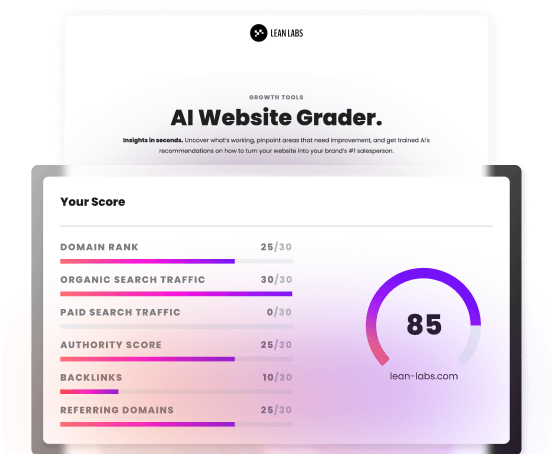
You can run your current site through GrowthGrader.com to get a baseline read on where things stand. And if you want to talk through whether GDD is the right fit, start here.

.png?width=500&height=500&name=36%20(1).png)