%20(1).png?width=765&height=430&name=136%20(2)%20(1).png)
.png?width=660&height=543&name=Frame%201984077310%20(1).png)
 Initial HubSpot setup
.png?width=500&height=500&name=15%20(1).png)
Who are the top 10 conversion-focused North American website agencies for B2B startups
Design-Led Studios
Design-led studios are built around visual craft, which shapes everything from how they pitch to how they document results. Their case studies tend to describe aesthetics, brand system depth, and animation rather than conversion rate or pipeline contribution.
They're the right hire when your messaging is already strong, your pipeline is healthy, and what you want is a visual rebrand. Their best work happens when strategy is settled and the remaining question is execution quality.
Before signing, ask for two case studies where the primary success metric was a business outcome rather than a design award. An honest studio will tell you that isn't what they sell, which leaves you to decide whether it's what you need. Project pricing typically runs $30,000 to $80,000 and frequently excludes copy and strategy, so budget for supplying those yourself or hire for them separately.
Full-Service Brand Agencies
Full-service brand agencies are built for post-Series B companies rebranding across product, marketing, sales, and web simultaneously. Their engagement models assume a 6 to 12-month timeline and a committee of stakeholders on your side, and the senior team that wins the pitch usually hands off to a delivery team after you sign.
This archetype fits when you're rebranding across every channel, you have $250K+ committed, and you need brand, product, and web work running in parallel. Without all three of those conditions, you end up paying full-service rates for scope you won't use.
What you need to verify is who manages your account week to week, and what their client load looks like separate from the pitch team's. Full-service engagements typically start at $150,000 and reach $500,000 or more, and mid-market implementations at that price band regularly land between $100,000 and $250,000+ in year one once platform and integration work stacks on top of the creative.
Growth-Focused Website Agencies
Growth-focused agencies treat the website as a revenue system, which is why strategy, copy, design, build, and post-launch optimization all sit under one roof. Their case studies lead with conversion lift, marketing qualified leads (MQL), and pipeline attribution.
They fit companies between $1M and $30M ARR running on HubSpot or considering it, particularly when conversion sits under 2% and messaging looks like the cause. What you're buying from this agency is a system plus the ongoing work of improving it, which is a different purchase than a project with a delivery date.
Verify SaaS case studies at your ARR band with named metrics attached. Launch fees per this B2B SaaS pricing survey typically run $50,000 to $180,000, usually paired with a continuous-improvement retainer that runs $3,000 to $10,000+ per month.
To see how these archetypes compare against specific firms, we keep a running review of the best inbound marketing agencies and a deeper look at the top B2B SaaS growth marketing agencies.
|
Archetype |
Launch price band |
Best fit |
What to verify |
|
Design-led studio |
$30K to $80K |
Rebrand with pipeline already healthy |
Business-outcome case studies, not just aesthetic ones |
|
Full-service brand |
$150K to $500K+ |
Series B+ rebranding across every channel |
Day-to-day delivery team, not the pitch team |
|
Growth-focused website |
$50K to $180K + retainer |
$1M to $30M ARR with sub-2% conversion |
SaaS case studies with conversion lift and pipeline metrics |
What Matters at the $1M to $10M Stage
The bar moves once you cross $1M ARR, because now you have real traffic, real leads to lose, and revenue tied to how the website performs. Four things now carry more weight at this stage than anything else:
Messaging and Positioning Come First
Sub-2% conversion usually traces back to messaging rather than design. SaaS landing pages sit at a 3.8% median per Unbounce, well above the whole-site average, and what separates the median from the top quartile is clarity about who the product serves, what problem it solves, and why the buyer should care now.
Any agency worth hiring runs positioning and ideal customer profile (ICP) work before design begins. Ask directly whether they rewrite the site's copy or expect you to supply it, because "supply it" means you're buying a well-designed version of the messaging problem you already have.
Built to Generate Leads, Not Just to Explain the Product
The website needs to connect to your customer relationship management (CRM) platform from the first week. Forms, calls-to-action, lifecycle stages, and lead scoring belong in the original scope, so an agency that files HubSpot or Salesforce integration under "phase two" is quietly descoping the part that makes the site measurable.
Ask how they connect the site to sales pipeline attribution. A useful answer covers lifecycle stage mapping, form-to-record architecture, and how the marketing-to-sales handoff gets tracked, because vague answers here tend to mean attribution won't survive launch week.
For teams already on HubSpot, our approach to lead generation websites covers what that integration architecture looks like end to end.
.png?width=1390&height=754&name=Growth%20Playbook%20Image%20(1).png)

HubSpot or CMS Fluency
If you run HubSpot, hire an agency that works inside the HubSpot content management system (CMS) daily. Migrations and integrations are where non-specialist agencies lose timelines, and a botched migration can cost you long after signing up. US-based HubSpot agencies typically charge $150 to $300 per hour or $12,000 to $60,000+ per implementation, and the gap between a certified partner and a generalist tends to surface in month two rather than day one.
Ask about certified HubSpot experience, past migrations, and the specific integrations they've shipped, whether that's Salesforce, Segment, or product analytics tooling. An agency with a real HubSpot practice can describe its migration playbook without stalling.
Post-Launch Optimization Model
Sites decay within 12 to 18 months without ongoing optimization, so whether an agency has a continuous-improvement model attached determines whether your site keeps compounding or quietly stalls after launch.
Growth-driven design (GDD) is the standard framework here: you ship a launchpad version, then iterate monthly against real data. GDD retainer rates at certified agencies typically run $2,000 to $6,000 per month, and most post-launchpad engagements run nine to twelve months after the launchpad goes live. Ask what month four looks like after go-live, since agencies selling projects and agencies selling systems answer that question very differently.
Our own approach is documented in growth-driven design and the three stages of GDD.
The Questions Strong Agencies Can Answer
Three questions reliably separate agencies with real delivery depth from agencies with a strong portfolio and a thin bench. Ask all three before signing anything.
Prove SaaS/B2B Fit at Your ARR Band
Ask for three to five case studies from companies between $1M and $30M ARR, and look for named metrics: conversion lift, qualified lead volume, pipeline attribution. "We work with SaaS" without specifics isn't an answer.
Stage fit matters more than client portfolio, because an agency that does excellent Fortune 500 work may not know how to scope for a lean growth-stage team, while an agency full of impressive seed-stage logos may not have the depth for a $10M ARR company with a real sales motion. Match the stage first, then evaluate the quality of the work.
Confirm Who Actually Does the Work
Senior strategists in the pitch and a junior team on delivery is the most common substitution in agency selection, so ask who your day-to-day contact will be, what their previous work looks like, how many active accounts they carry, and request a delivery-team org chart before signing.
What you want to see is continuity. The senior strategist who ran the pitch should keep some role, even if that's a monthly strategic review rather than daily execution, because when the pitch team disappears entirely you end up paying a delivery team to learn your business from scratch.
Pricing Transparency and Scope Boundaries
Ask for a written scope covering revision rounds, change-order pricing, and timeline penalties. Any agency working at the launch band described above should be able to hand you a scope document without gating it behind a discovery call, so treat "we'll figure it out as we go" pricing as a decline.
The most revealing question is what the proposal excludes. A tight proposal names copy, strategy, integrations, migrations, and post-launch support as individual line items, while a loose one folds them into "included" without specifics and then bills the difference as change orders once you're committed. For deeper context on the ranges, we've published breakdowns of digital growth agency pricing and growth marketing agency pricing.
Getting a Second Opinion Before You Shortlist
If you're between $1M and $10M ARR and the site isn't pulling its weight, a diagnostic will scope the real problem faster than another round of agency pitches. Three sales calls get you three proposals for the version of the problem each agency is best equipped to solve, which is genuinely useful information once you already know what you're buying.
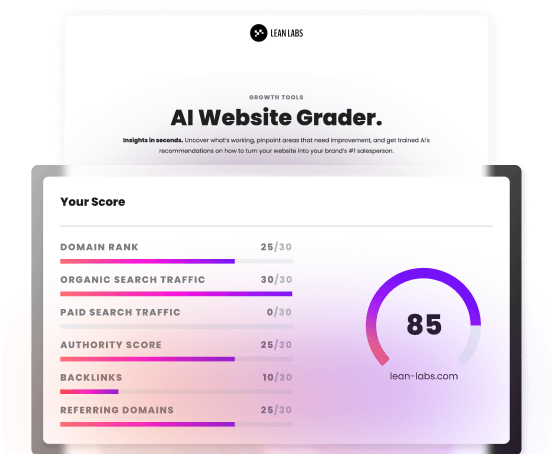
The Growth Grader runs the same framework we use to scope website engagements, including a free marketing maturity assessment and a website copy critique against your ICP and current funnel. Use it to work out whether you need a full rebuild, a messaging refresh, or a retainer partner before you send a proposal request to anyone, because a sharper read on the problem produces a much shorter shortlist.


.png?width=500&height=500&name=7%20(1).png)