

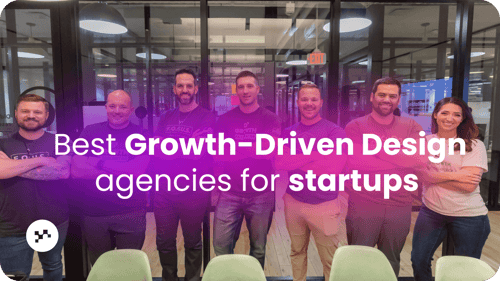
What Are the Best Growth-Driven Design Agencies for Startups?
The agency choice matters more than the methodology label because GDD requires monthly sprint discipline, prioritization scoring, and actual conversion optimization skill. A weak agency runs GDD as a slow drip of cosmetic changes (new hero image this month, footer redesign next month) without tying any of it to a measurable outcome. A strong one ties every sprint to a target metric: lead volume, demo requests, trial signups, or a specific conversion rate on a specific page. The difference shows up in how the agency builds the site itself, modular components designed for fast iteration, or fixed templates that resist change.
Industry fit shapes the work too. B2B SaaS GDD focuses on demo requests, trial-to-paid lift, and product page conversion. Nonprofit GDD focuses on donation flow and volunteer signup. Ecommerce GDD focuses on cart abandonment and product-detail page optimization. The methodology is the same; what gets prioritized and how experiments are scored is not. An agency without industry depth will run generic experiments that drift toward cosmetic changes, which is the single most common failure mode in retainer-based website work.
How We Evaluated These Agencies
Five criteria shaped the list. GDD discipline: do they actually run monthly sprints with a written prioritization framework, or is "GDD" a relabeled retainer. Industry fit: which buyer profile they serve best (SaaS, B2B services, nonprofit, ecommerce, enterprise). CMS alignment: HubSpot, WordPress, custom, and whether they're CMS-flexible or specialized. Pricing transparency: whether the model is clear (launch pad plus monthly retainer) and what the typical range looks like. Proof: case studies with conversion or lead metrics, not "look at this pretty site."
This is not a paid ranking. Agencies are grouped by ideal-fit client, not ordered "1 is best." The order below reflects how often each agency comes up in HubSpot-ecosystem buyer research, not a quality ranking.
Lean Labs, Best for B2B SaaS on HubSpot
Snapshot:
- Headquartered: Remote, U.S.-based
- Specialty: Lead generation websites and GDD for SaaS and B2B brands on HubSpot
- Typical client size: $3M-$30M ARR
- Pricing model: Launch pad plus monthly growth retainer
We run a HubSpot-native version of GDD that combines a 3-9 week launch pad build with monthly optimization tied to lead and conversion targets. Our philosophy is that messaging is upstream of design. A beautiful site with a weak value proposition will underperform a plain site with sharp positioning, every time. We sequence work that way too: strategy and messaging first, then asset performance, then design polish. The reason that order matters is most underperforming sites we audit have a positioning problem, not a design problem.
We're built for high-growth B2B SaaS and B2B tech companies between $3M and $30M ARR who are already on HubSpot or planning to migrate and want a partner who handles messaging, copy, design, and the growth program after launch. The proof is in the lead metrics, not the visuals. We've reported 355% more qualified leads at Atlantech Online, 50% more organic leads and 129% more organic traffic at POS Nation, 245% lead generation lift at Integrate, and 300% more qualified leads with 5x demo requests at The Predictive Index. Each engagement starts with the same lead generation website framework and adapts to the client's stage.
What we get right: HubSpot CMS depth (we built Sprocket Rocket on top of it), messaging-first sequencing, and a launch pad pace measured in weeks instead of months. The HighByte launch is a representative example of how the model runs end-to-end.
Lean Labs isn't a good fit if you:
- Need a pure WordPress or custom-stack build (we're opinionated about HubSpot)
- Are pre-revenue or under $1M ARR (the model assumes a real growth budget)
- Want a one-time project with no ongoing retainer
Jumpfactor, Best for B2B and SaaS Lead Generation Execution
Snapshot:
- Headquartered: Toronto, Canada
- Specialty: Execution-focused GDD with structured sprint cycles
- Typical pricing: $2K-$6K per month retainer range, in line with B2B agency benchmarks
Jumpfactor is built for B2B and SaaS companies that want visible monthly progress on a scoreboard. Their philosophy is revenue alignment, where every design decision ties back to a lead or pipeline metric scored before the sprint starts. The structured Strategy → Launch Pad (4-8 weeks) → monthly sprint cycle keeps the work predictable, and the scoring model removes the "trust our taste" problem that derails so many retainer engagements.
What Jumpfactor gets right is the operating cadence. If you've ever signed a website retainer and watched the work slow to a trickle by month three, the answer is usually missing sprint structure. Jumpfactor's structure is the antidote. They're also one of the few Canadian-headquartered agencies with deep B2B chops, which matters for buyers who want a North American partner inside the same time zones as their team.
Jumpfactor isn't a good fit if you:
- Need deep HubSpot CMS specialization (they're CMS-flexible, not HubSpot-native)
- Want a partner who'll also rebuild your brand strategy and positioning from scratch
O8 Agency, Best for SaaS Conversion Optimization on Existing Sites
Snapshot:
- Headquartered: Minneapolis, U.S.
- Specialty: B2B and SaaS conversion improvements, MVP builds, quick wins from existing assets
O8 leans on the continuous improvement half of GDD harder than the launch pad half. Rather than rebuilding from scratch, they often extract quick wins from your existing site through experimentation and UX refinement. Their philosophy is MVP-first: before they propose a launchpad rebuild, they look at what's already on the site and ask what can be improved this month with the assets you already have.
The reason O8 is on this list is they're built for SaaS teams where small UX changes can move trial signups and lead quality. If your existing site has SEO equity worth protecting and you can't afford three months of agency research-mode, O8's sequence starts with conversion work on existing high-traffic pages first, then graduates to a launch pad if the data supports it. That's a sharper fit for stage-fit-mid teams than the typical "blow it up and start over" agency posture.
O8 Agency isn't a good fit if you:
- Have a genuinely outdated site that needs a real rebuild
- Need HubSpot CMS expertise specifically
Ironpaper, Best for Full-Service B2B Web and Marketing
Snapshot:
- Headquartered: New York, U.S.
- Specialty: Full-service B2B digital marketing with GDD inside a broader program
Ironpaper applies GDD as one piece of a broader B2B marketing program. Their philosophy is that demand generation and pipeline development are one program, and the website is a tool inside it. Pairing the site work with content, demand gen, and reporting means validation happens as you build, which lets phases ship with less waste than a website-only engagement.
Ironpaper is built for mid-market B2B buyers who want one agency owning website plus demand gen, and who've already invested in content that needs to be tied together. The trade-off is scope. If you only need a website, Ironpaper isn't the lean engagement you're looking for. Their delivery model is built around a broader RevOps scope, and a $3K monthly budget won't reach it.
Ironpaper isn't a good fit if you:
- Want a HubSpot-specialized partner
- Are looking for a focused website engagement, not a full marketing program
Mole Street, Best for HubSpot CMS-Native GDD
Snapshot:
- Headquartered: Philadelphia, U.S.
- Specialty: HubSpot growth-driven design with strong CMS implementation depth
Mole Street is built for HubSpot customers who want website and HubSpot platform optimization in one engagement. Their philosophy is that the website is one surface inside a HubSpot deployment, and the ROI of GDD compounds when sprint work also touches the CRM, the workflows, and the reporting. They run A/B tests, weekly reporting, and quarterly readouts that surface additional ROI opportunities inside HubSpot itself, not just on the public-facing site.
What Mole Street gets right is the HubSpot-as-platform thinking. Most GDD shops treat HubSpot as the CMS layer. Mole Street treats it as the full operating system and runs sprints that maximize the platform investment, not just the website. The weekly reporting cadence is faster than the monthly default most agencies offer, which is the right call when sprint velocity matters to a HubSpot-native team.
Mole Street isn't a good fit if you:
- Aren't on HubSpot
- Want a partner with deep SaaS-specific positioning experience
IMPACT, Best for Strategy-Led Redesigns Tied to a Broader Marketing Plan
Snapshot:
- Headquartered: Connecticut, U.S.
- Specialty: GDD inside the They Ask, You Answer content framework
IMPACT is built for buyers who don't have a clear growth strategy yet and want help building one before any pixels are pushed. Their philosophy is that strategy is upstream of execution, and they run an intensive multi-week strategy phase before launch pad work begins. They explicitly will not start a website project for a company without a clear growth plan.
The reason IMPACT is on this list is the strategic rigor. If you've bought into the They Ask, You Answer / content-led approach and you want a website that's an execution layer on top of a written content strategy, IMPACT is the answer. The trade-off is a slower start. If you already have a clear strategy and just need execution, the upfront phase will feel like a tax.
Impact isn't a good fit if you:
- Already have a clear strategy and just need execution
- Want to launch the launch pad faster than five-plus weeks of strategy work allows
Get a Second Opinion Before You Commit
If you've narrowed your shortlist to two or three GDD agencies and want a sanity check before signing, we'll give you one. Book a Growth Strategy Meeting and we'll review your current site, the messaging gaps that are likely capping conversion, and the highest-impact moves a strong GDD partner should make in the first 90 days. If we're the right fit, we'll tell you. If someone else on this list is a better match for your industry or stack, we'll tell you that too. The cost of picking the wrong partner is six months and $30K to find out the sprint cadence isn't moving the metrics, and the diagnostic conversation costs nothing.