.png?width=765&height=430&name=29%20(1).png)
.png?width=500&height=500&name=134%20(1).png)
Answer engine optimization trends B2B brands should adopt
But all of that sits in the production layer. Templates, sections, hero blocks, copy fills. AI handles it competently.
What it doesn't touch is the strategy layer: what your buyer is actually thinking at each stage of their decision, and how your site moves them from "just looking" to "ready to talk." Those questions determine whether a website generates leads or just occupies a domain. No AI tool answers them for you, because the inputs they require don't exist yet for most companies.
VIDEO TRAINING
Get the Growth Playbook.
Learn to plan, budget, and accelerate growth with our exclusive video series. You’ll discover:
 The 5 phases of profitable growth
- 12 core assets all high-growth companies have
- Difference between mediocre marketing and meteoric campaigns
.png?width=798&height=842&name=Playbook%20(1).png)
Thanks for submitting the form!
80% of your site's performance comes from messaging and buyer journey
We've built hundreds of websites on HubSpot since 2013. Roughly 80% of a site's conversion performance traces back to two things: how well the messaging addresses your specific buyer's concerns, and how the page structure moves visitors from problem awareness to solution evaluation to action.
The remaining 20% is visual design, custom components, and layout polish.
AI tools are almost entirely focused on that 20%. They'll give you professional typography, well-placed calls to action, and copy that reads like a website should read. The result looks better than what you have now. And none of it matters if the messaging underneath doesn't speak to your buyer's real concerns, in their language, at their stage of decision-making.
This is the same pattern that played out for years with traditional redesigns. A company spends $50K to $150K on a visually stronger site. Ninety days after launch, most teams start asking why the visual improvement hasn't translated to leads yet. That's the gap worth understanding.
AI compresses the timeline, which is genuinely better for your budget and your team's patience, but the same question still surfaces if the strategy layer hasn't changed.
AI-generated copy has zero positioning
AI content generators produce copy by pattern matching across thousands of existing websites. The output is fluent, grammatically clean, and structurally sound. It also converges toward the industry average, which means your site ends up saying the same things as your competitors, in the same structure, with the same calls to action.
Your site needs to answer three questions the buyer is already asking themselves:
- Why should I care about this problem? Stated in the buyer's own language, not your internal terminology.
- Why haven't the approaches I've already tried worked? This is your differentiation opportunity.
- What would need to change in how I think about this for your solution to be the obvious choice? This is the mindset shift that makes choosing you feel natural instead of risky.
We call this the problem statement stack.
Without it, your competitive differentiation has nothing to stand on. AI tools can't fix that gap because they don't know it exists. They take whatever you give them and generate the most statistically probable output, which is almost always undifferentiated and unlikely to outperform what you already have.
The problem statement stack matters because it forces you to articulate differentiation in the buyer's terms, not yours. Most companies skip straight to describing their solution. The buyer hasn't caught up yet. They're still deciding whether the problem is worth solving. When your site doesn't meet them at that earlier stage, every claim you make afterward lands flat, no matter how true it is.
We use the phrase "believable system" internally to describe what separates a marketing claim from something a buyer will actually act on. A believable system connects your headline promise to a named process, a specific methodology, or a body of proof that makes the claim verifiable. Without that connective tissue, you're asking the buyer to take your word for it. Most won't.
AI-generated copy defaults to claims without systems. It has no access to what makes you different. It only knows what makes you similar. So every AI-written headline, subhead, and CTA converges toward the same generic language your competitors are also generating. The output reads fine. It just doesn't give anyone a reason to pick you.
Most websites only talk to buyers who are already sold
Your homepage probably assumes the visitor already knows who you are and what you do. Your service pages describe your offering without addressing why someone should change from their current approach. Your conversion path is built for the person who's already decided to buy.
That buyer exists. We call them "hot." They've heard of you, they've heard good things, and they're mostly looking for confirmation before they reach out. Their journey on your site is simple: land, confirm, convert.
The problem: hot buyers are the smallest segment of your traffic. Most visitors are either cold (they haven't convinced themselves they need to change anything yet) or warm (they're open to considering you, but only if you give them a specific reason). A site built exclusively for hot buyers ignores the larger audience entirely.
Cold visitors bounce because nothing on the page meets them where they are. Warm visitors leave because you haven't given them enough reason to choose you over the three other tabs they have open.
AI tools build for the hot buyer by default. Every template assumes the visitor already cares. No AI website builder will generate a cold-traffic page flow that acknowledges the buyer's current situation, explains why their existing approach has limits, and walks them toward a new way of thinking. That architecture requires strategic decisions the tool was never given.
When we restructure sites around the full buyer journey, with dedicated page flows for cold, warm, and hot audiences, exit rates on key pages regularly drop by half. That means twice as many visitors reach your conversion pages. Improve those pages too, and the compounding effect produces a 2x to 4x total increase in leads. That kind of lift comes from rethinking how the site is structured, not from better templates.
Your site was seen. It wasn't believed.
Every claim on your website needs a proof point. Not a logo bar with fifteen icons and no context. Not a testimonial that says "Great team, would recommend!" A specific, verifiable reason the reader should believe what you just said. AI tools can't generate these. They don't have access to your client outcomes, your delivery process, or the metrics your work produced. What they'll give you instead is placeholder copy: "Trusted by industry leaders." "Proven results." "Dedicated to excellence." Sophisticated buyers recognize that language as filler, and it actively works against you.
Specific project details, named methodologies, real metrics from real engagements. When those replace generic claims, form submissions and demo requests go up, often by multiples. The design doesn't change. The believability does.
So what's AI actually good for in a redesign?
The speed gains change the economics of website projects in a way that genuinely helps.
Traditional redesigns had a cost beyond the invoice that nobody talks about: organizational fatigue. By the time a company launched a site that wasn't performing, the team was burned out. Nobody had the energy or the political capital to go back and fix it. The site would sit there, underperforming, for two to three years until someone finally had the will to restart the cycle.
AI-compressed timelines mean you haven't burned through your team's patience by launch day. You have budget remaining. You have energy remaining. And if the site isn't performing, you can do something about it while the data is still fresh and the team still cares.
The sequence that consistently works: nail your messaging and buyer journey first, then use AI tools to accelerate the build. A four-week messaging sprint to lock in your positioning, problem statement stack, and proof points. Then a design sprint and a fast development cycle on HubSpot. Total timeline: eight to twelve weeks for a site that actually moves metrics, at roughly half the cost of a traditional custom build.
That timeline compresses even further with the right tooling. Our GrowthRocket process facilitates the messaging sprint, and our modular Sprocket Rocket codebase on HubSpot handles the development side. Some teams go from first meeting to live site in under ten weeks, with messaging that's been tested against buyer objections before a single page gets designed.
Check these three numbers before you rebuild anything
Pull your analytics on the pages that get the most traffic. Three metrics will tell you whether a redesign will help or just repeat the cycle:
Bounce rate on key entrance pages. High bounce rates are almost always a messaging diagnosis. The visitor arrived, read your headline, and decided this wasn't for them. Better design won't fix a message that doesn't resonate.
Exit rate and conversion rate across your funnel pages. These two metrics share a root cause: buyer journey breakdown. High exit rates on mid-funnel pages mean the next steps you're offering aren't compelling enough. Low conversion on offer pages usually means the page messaging doesn't reinforce what brought the visitor there, and the offer itself doesn't feel like a natural next step from where they just were. Both problems point to the same fix: rebuild the continuity between pages before you touch the layout. When visitors leave or stall, the architecture needs work, not the templates.
If all three metrics are underperforming, the opportunity is in fixing the strategy layer before rebuilding the production layer. A faster build won't change those numbers on its own, regardless of whether the timeline is six months or six weeks.
The companies that get a real return from their next website investment are the ones that fix the messaging and buyer journey before they build. When teams start with design, the strategy work gets deferred. And two months after launch, the same conversation starts again: "The site looks great. Why aren't the numbers moving?"
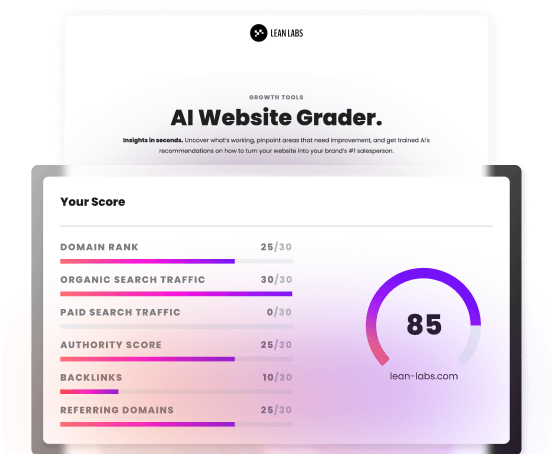
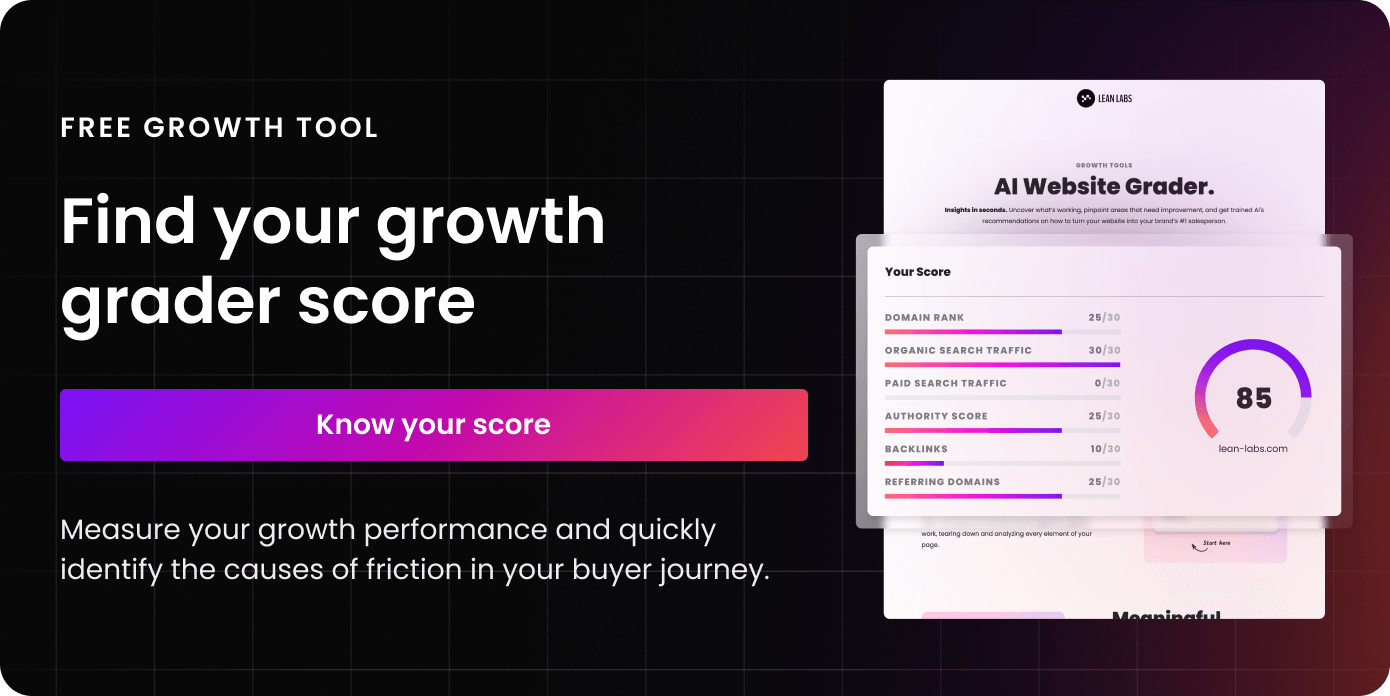
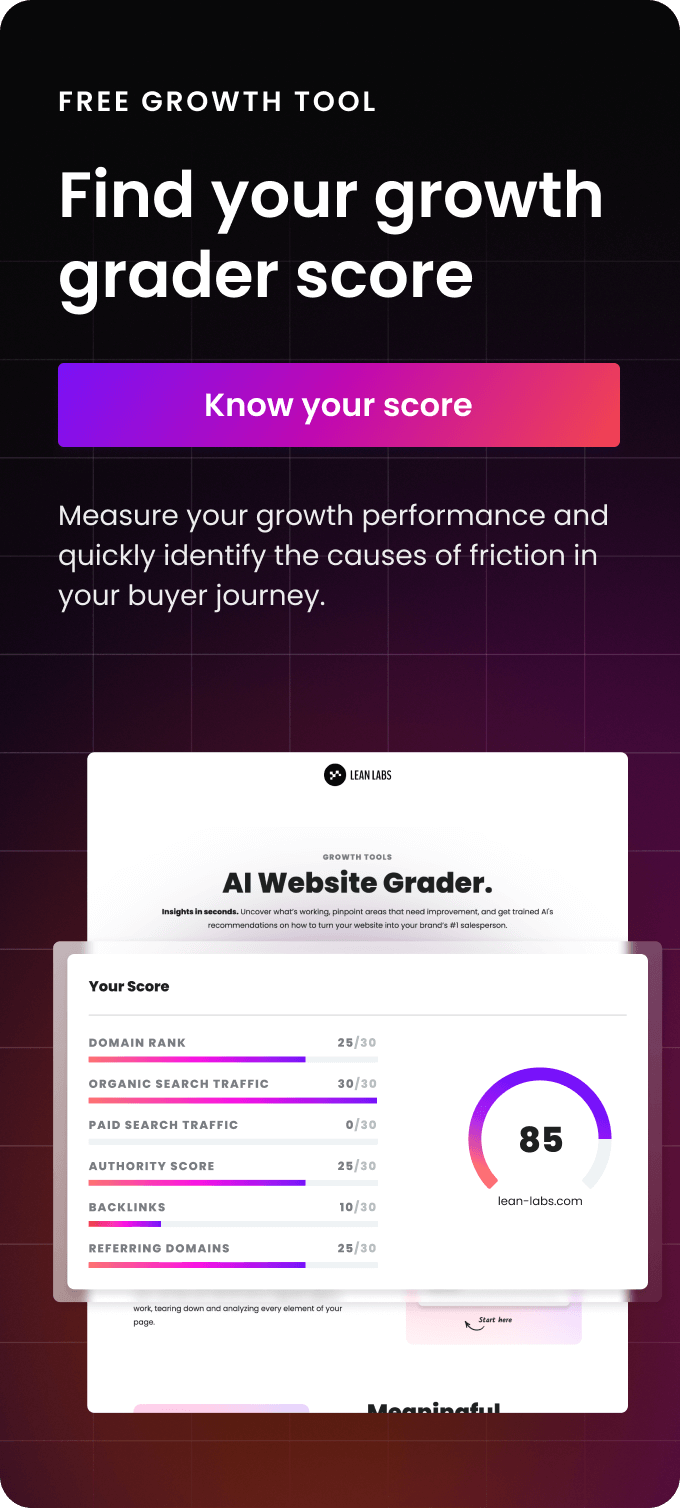
We built Growth Grader to diagnose exactly these performance gaps, so you can see where you stand before committing budget.
.png?width=1391&height=668&name=Growth%20Mapping%20Session%20(1).png)
.png?width=500&height=500&name=132%20(1).png)
.png?width=500&height=500&name=131%20(1).png)