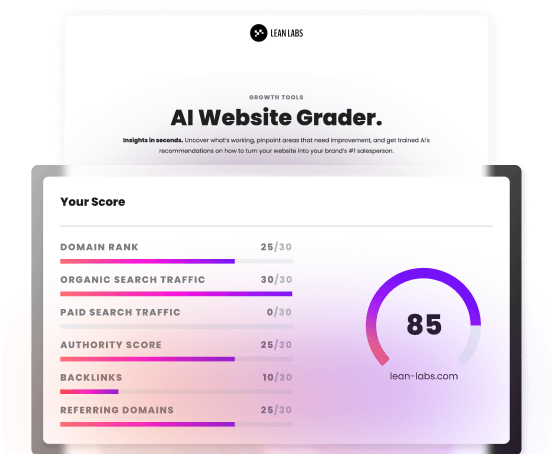
%20(1).png?width=765&height=430&name=25%20(1)%20(1).png)
.png?width=500&height=500&name=134%20(1).png)
Answer engine optimization trends B2B brands should adopt
The output defaults to generic. Professional-sounding copy. Best-practice layout. CTAs in the expected spots. But nothing that positions you differently or gives your specific buyer a reason to choose you over four other companies whose sites look nearly identical.
We've met with roughly 1,200 companies. Fewer than 5% have the strategic foundation that would let AI produce something with real positioning out of the box. The other 95% hand it a company name, a service list, maybe a tagline. And they get back something that looks complete but reads like the average of their industry.
The average is exactly what buyers are already ignoring.
VIDEO TRAINING
Get the Growth Playbook.
Learn to plan, budget, and accelerate growth with our exclusive video series. You’ll discover:
 The 5 phases of profitable growth
- 12 core assets all high-growth companies have
- Difference between mediocre marketing and meteoric campaigns
.png?width=798&height=842&name=Playbook%20(1).png)
Thanks for submitting the form!
Speed kills the strategic conversation
AI collapses the build timeline to days. Sometimes hours. And the strategic conversations that used to happen across a three-to-five-month build don't get replaced. They get skipped entirely.
That old timeline was painful, but it forced strategic work along the way: kickoff meetings, stakeholder interviews, copy review rounds. Some of that friction was productive. It surfaced the hard questions about who your buyer actually is and what they need to hear.
A team sits down with an AI tool, describes their company in a few sentences, and gets a full site layout with copy by lunch. It looks finished. So the instinct is to start tweaking colors and fonts rather than questioning the messaging underneath. The deliverable arrived so fast that everyone moved straight from "we need a website" to "let's polish this website" without passing through "what does our buyer actually need to hear from us?"
What AI doesn't know about your buyer
About 80% of a website's performance comes from messaging and buyer journey. The remaining 20% is design, layout, and visual polish. AI is extraordinarily good at the 20%. It has almost no ability to address the 80% without explicit, detailed inputs from you.
Messaging is the work of understanding what your target buyer thinks at each stage of their decision. A cold buyer hasn't decided they need to change anything yet. A warm buyer is comparing options. A hot buyer is ready to talk. A site that speaks to all three converts dramatically better than one that only addresses the buyer who already knows they want your product.
AI doesn't know your buyer's doubts. It doesn't know the objections your sales team fields on every call or which proof points would actually neutralize skepticism. Your three-step onboarding process might be the thing that actually closes deals. Your guarantee structure might remove the exact risk your buyer is afraid of. None of that is in the training data.
Without those inputs, AI produces what we call a "we do it too" website. It confirms your company exists and lists your services with a contact form at the bottom. So does every one of your competitors. The buyer has no mechanism for choosing between you, so they default to price, or to whoever their colleague recommended, or they just leave.
95% of companies skip the foundation that makes AI useful
The pattern across hundreds of go-to-market positioning engagements is consistent: almost nobody has done it before they start building. Nine out of ten brands we work with haven't figured out their problem statement stack. They don't have their differentiation articulated as a mechanism. Their proof points aren't organized. Their buyer's language hasn't been captured.
That's not a criticism. Building a company is hard, and most founders and marketing teams are too close to their own product to see it through the buyer's eyes. But it means the brief they hand to AI is thin. And thin inputs produce output that sounds like everyone else.
The foundation that actually makes AI useful is what we call the problem statement stack, paired with a believable system:
- Problem statement, level one: The buyer's problem in their own words. Not your internal jargon. The actual phrases they use when describing their pain to a colleague.
- Problem statement, level two: Why the alternatives have failed. What the buyer has already tried, and the structural reason it didn't work.
- Problem statement, level three: The mindset shift. The reframe that makes your approach the obvious choice. Not incrementally better. Categorically different.
- A believable system: Your specific, named methodology that gives buyers a reason to believe you can deliver what you promise. Not a tagline. A structured explanation of how you do what you do and why it works.
That work typically takes two to four weeks of focused effort. Once it's done, AI produces positioned, differentiated content instead of generic output. Copy that actually sounds like your company, not the industry average.
What happens when visual polish hides a messaging gap
This pattern repeats constantly. Companies put their budget toward how the site looks and assume performance will follow. AI has made this pattern faster and cheaper to repeat, but the outcome hasn't changed.
Before AI tools, a $50K to $150K redesign might take five months and still not move the metrics. The structural issue was always the same: not enough strategic work built into the process. AI collapses that timeline but doesn't change the underlying dynamic. If anything, the polish of AI output makes the gap harder to spot. A hand-built site with weak messaging at least looked like it might need work. An AI-built site with weak messaging looks finished.
Feed AI the right inputs and it performs
AI saves serious time when you feed it the right inputs. We use it across our own workflow: research, outlining, drafting, quality checks. But every one of those AI steps runs on a strategic foundation built by humans first.
If you're planning a website project that involves AI, do the messaging and positioning work before anything else. Interview your sales team. Listen to six recent sales calls and extract the language your buyers actually use. Document your problem statements at all three levels. Build out proof points for every claim you plan to make.
Then give that context to AI and let it draft. The output will be dramatically different from what you'd get by pointing AI at your current site and saying "make it better."
Three checkpoints that catch false confidence early:
Before generation: Can you articulate, in your buyer's language, the specific problem you solve and why your approach is different from alternatives they've tried? If you can't say it clearly in conversation, AI won't produce it in your copy.
After the first draft: Read it as a buyer comparing three companies. Does the copy give you a specific reason to choose this company? Or could you swap in a competitor's name and the page would still make sense? If the answer is yes, the positioning work hasn't been done.
Two weeks after launch: Check bounce rates and conversion rates against your previous baseline. If they haven't moved, the issue is messaging. Not design.
Copy converts. Layout doesn't.
Both a converting site and a failing site can have clean layouts, modern typography, and well-placed CTAs. The difference is whether the copy addresses buyer concerns in the right sequence, whether the page structure moves someone from "I'm not sure" to "tell me more" to "let's talk," and whether every claim is backed by something the buyer can verify.
AI builds the container. It's good at that. The substance that goes inside, the positioning, the proof, the buyer journey, still requires strategic thinking that no tool can shortcut. Do that work first, and AI becomes the most efficient production partner you've ever had. Skip it, and you'll launch a beautiful site that quietly underperforms while everyone wonders what went wrong.
If you're planning a redesign and want to see what a strategy-first approach looks like, our process page walks through how we structure the work. And if you want to see what it produces, our case studies show the numbers.
.png?width=1391&height=668&name=Growth%20Mapping%20Session%20(1).png)
.png?width=500&height=500&name=132%20(1).png)
.png?width=500&height=500&name=131%20(1).png)