.png?width=765&height=430&name=58%20(1).png)
.png?width=500&height=500&name=134%20(1).png)
Answer engine optimization trends B2B brands should adopt
|
Mistake |
Why it keeps you out of AI answers |
The fix |
|
Burying the answer |
Models extract the most direct response to a query, so a section that opens with windup gets skipped for one that gets to the point |
Lead every section with a complete, standalone answer in the first one or two sentences |
|
Thin content |
Generic pages give a model nothing specific to quote and no signal that an expert wrote them |
Write from practitioner experience with real numbers, named tools, and concrete process |
|
Blocked crawlers |
If the bots that feed AI systems can't fetch your page, none of the content matters |
Audit your robots.txt and allow the relevant AI crawlers to read your content |
|
Inconsistent entity signals |
When your name, description, and core facts vary across the web, a model can't confidently place or trust your brand |
Standardize your entity details everywhere and reinforce them with schema |
|
No measurement |
Without tracking citations, you can't tell which pages work, so you keep guessing |
Sample a fixed set of priority prompts on a schedule and record who gets cited |
|
Chasing volume over fit |
High-volume keywords are crowded and often a poor match for what your brand can credibly answer |
Target specific questions where your expertise gives you a real shot at the citation |
VIDEO TRAINING
Get the Growth Playbook.
Learn to plan, budget, and accelerate growth with our exclusive video series. You’ll discover:
 The 5 phases of profitable growth
- 12 core assets all high-growth companies have
- Difference between mediocre marketing and meteoric campaigns
.png?width=798&height=842&name=Playbook%20(1).png)
Thanks for submitting the form!
Why does burying the answer keep content out of AI answers?
Burying the answer is the mistake that costs the most citations, because AI systems pull the most concise, complete response to a query and move on. A section that opens with three sentences of context before the actual answer gives the model nothing to extract early, so it tends to skip that section and quote a source that reached the point faster. The content might be excellent further down, but a model rarely reads that far when a cleaner answer exists elsewhere.
The fix is to lead every section with a complete answer in the first one or two sentences and treat the rest as supporting evidence. Each key paragraph needs to read as a full answer on its own, because a sentence that only makes sense after the paragraph before it can't be lifted out as a standalone snippet, and standalone snippets are what get cited. We write the opening sentence of every section as if it's the only line that will ever appear in an AI answer, since on plenty of queries it is. The same logic applies to headings, which is why phrasing them as the actual questions people ask gives the model a cleaner match to the query it's trying to satisfy.
How does thin content hurt your AI search visibility?
Thin content keeps you out of AI answers because it gives a model nothing specific to quote and no signal that a real expert wrote the page. A page that restates what every other page on the topic already says reads as interchangeable, so a model has no particular reason to cite you over the dozen sources that said the same thing. AI systems are tuned to surface content that demonstrates first-hand experience, and generic summaries carry none of that.
Fixing thin content comes down to writing from things only a practitioner would know. Real numbers and named tools, along with the specific processes and hard-won detail you only pick up by doing the work, all tell a model that a working expert is behind the page. We've found that a single page going deep on a narrow question tends to get cited far more than a broad page skimming the surface of ten, because the narrow page can say something concrete that the broad one never gets room to. When you replace vague claims with the specifics you've actually observed, the page reads as a credible source a model can quote rather than another interchangeable summary.
What happens when AI crawlers can't access your content?
When the crawlers that feed AI systems can't fetch your pages, none of your content can be cited regardless of how good it is. Many AI systems read the web through their own user agents, and a robots.txt rule, an aggressive firewall, or a bot-management setting that blocks those agents quietly removes your entire site from consideration. This is the mistake most likely to go unnoticed, because the page looks fine to you while being invisible to the models you're trying to reach.
The fix starts with auditing your robots.txt and bot-management rules to confirm the relevant AI crawlers are allowed to read your content. It's worth checking which user agents the major systems use and deciding deliberately which to permit, rather than letting a default block decide for you. Server-side rendering matters here too, since content that only appears after JavaScript runs may never load for a crawler that doesn't execute it, so the answer a model needs should be present in the raw HTML. Because we build on HubSpot and handle this with systematic entity markup and technical setup, crawlability and markup get handled at the platform level, which keeps the whole site readable rather than only the handful of pages someone remembered to check.
Why do inconsistent entity signals confuse AI systems?
Inconsistent entity signals keep your brand out of AI answers because a model builds its understanding of who you are from how your name, description, and core facts appear across the web, and conflicting details make that understanding fuzzy. When your company name is written three different ways, your description shifts from site to site, or your founding facts don't line up, a system can't confidently place your brand, and a source it can't place is a source it hesitates to cite. The expertise on the page might be real, yet the model never connects it to a trustworthy entity.
The fix is to make your entity unmistakable and consistent everywhere it shows up. Standardize your brand name, core description, and key facts across your site, your profiles, and any third-party mentions you can influence, then reinforce those facts with Organization schema so a system can read them directly. Author attribution does similar work at the page level, because a real byline with genuine credentials signals first-hand experience instead of content of unknown origin. The goal is for every place a model encounters your brand to tell the same story, since that consistency is what lets a system trust the name attached to your answers.
How does skipping measurement stall your AEO progress?
Skipping measurement keeps you stuck because you can't tell which pages get cited, which means you keep pouring effort into work that may not be moving anything. AI answers don't show up in your analytics the way a Google ranking does, since each answer is generated fresh and varies by user and phrasing, so a brand that doesn't deliberately track citations is essentially flying blind. Without that feedback, you can't tell a page that's winning citations from one that's invisible, and you end up optimizing on guesswork.
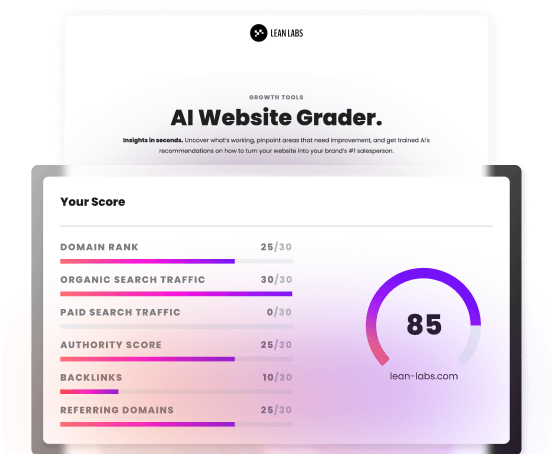
The fix is to sample AI answers on a schedule and aggregate what you find. Track a fixed set of priority prompts that matter to your business, record which brands get cited including your competitors, and watch whether your share of those answers rises or falls over time. A free baseline like HubSpot's AI Search Grader gives you an initial read on how systems perceive your brand before you commit budget to a paid tracker, and our AI website teardown flags the structural and crawlability issues working against you on the page itself. Measurement on its own doesn't move anything, so its real value is pointing the rest of your work at the right targets, since a prompt where you're invisible tells you exactly where to aim your next round of answer-first writing and content.
Why is chasing keyword volume the wrong AEO strategy?
Chasing high-volume keywords keeps your brand out of AI answers because the biggest, broadest queries are the most crowded and often the worst match for what your brand can credibly answer. A query with enormous volume usually has dozens of strong sources competing for the citation, and a model picks the one with the clearest, most authoritative answer, which is rarely the brand reaching outside its lane to chase the traffic. Volume looks appealing on a spreadsheet, but the number on its own says nothing about whether you can actually win that answer.
The fix is to target the specific questions where your expertise gives you a genuine shot. Narrow, intent-rich queries that sit squarely in your area of practice tend to have fewer credible competitors and a much closer match to what you can say with authority, so your odds of being the cited source go up even though the raw search numbers look smaller. We've found that owning a cluster of precise questions a buyer actually asks does more for AI visibility than ranking nowhere on a handful of giant terms. The questions worth pursuing are the ones where your real experience lets you answer better than the brands competing on volume alone.
Schema markup recommendations
Structured data is what makes the fixes above machine-readable, so it deserves a dedicated implementation pass rather than being bolted on at the end. Clear markup tells a system what each page is, which means the model spends less effort guessing and is more likely to use your content confidently. Because we build on HubSpot, we apply this systematically so it covers every relevant page instead of the few that get tagged by hand.
- Article schema on each page with author, datePublished, and dateModified populated, so systems can read authorship and recency directly and connect the page to a known entity.
- FAQPage schema on question-based sections that map to real queries, which makes those answers eligible to be extracted as standalone responses.
- HowTo schema wherever you've laid out a genuine step-by-step process, so a model can lift the ordered sequence and present it as instructions.
- Organization schema to make your brand entity explicit and consistent, which directly counters the inconsistent-entity mistake above.
- Validate everything with Google's Rich Results Test and the Schema.org validator before publishing, and keep dateModified current as you refresh the page, since freshness is a real signal on a topic that moves this fast.
Frequently asked questions about common AEO mistakes
What is the single most damaging AEO mistake in 2026? Burying the answer does the most damage, because AI systems extract self-contained answers and skip content that delays the point. A page can be expert, well-sourced, and technically clean and still lose the citation to a thinner page that simply led with the answer, so leading every section with a direct, standalone response is the first thing to fix.
How do I know if AI crawlers can read my site? Check your robots.txt and bot-management rules for the user agents the major AI systems use, and confirm your key content appears in the raw HTML rather than loading only after JavaScript runs. If an AI crawler is blocked or your answers render client-side, a model may never see the content, which makes this worth auditing before you invest in writing.
Is AEO different enough from SEO that my old content needs a rewrite? Most of your existing content can be fixed rather than rebuilt, since the common mistakes are repairable in place. You can rewrite the opening sentences of each section to lead with the answer, swap generic claims for specifics only you can offer, add question-based headings and valid schema, and start tracking your priority prompts, all without a full rebuild.
Should I target high-volume keywords for AI search? Volume is usually the wrong filter, because the biggest queries are crowded and often a poor fit for what your brand can credibly answer. Targeting narrow, intent-rich questions that sit in your area of expertise tends to win more citations, since there are fewer strong competitors and your real experience lets you answer better than brands chasing the traffic alone.
.png?width=1391&height=668&name=Growth%20Mapping%20Session%20(1).png)

.png?width=500&height=500&name=132%20(1).png)
.png?width=500&height=500&name=131%20(1).png)