.png?width=765&height=430&name=120%20(1).png)
.png?width=500&height=500&name=134%20(1).png)
Answer engine optimization trends B2B brands should adopt
The job differs from classic SEO in what it optimizes toward. Classic SEO works to rank a blue link on a results page, while AI search optimization works to get your brand quoted as the source when an engine answers a question directly. Because the goal has shifted toward citation, the deliverables changed too, which means a service still selling keyword positions and backlinks alone is likely built for an earlier version of search than the one you're buying for now.
A good provider treats these three layers as one connected program. In our experience the content, the schema, and the tracking all feed each other, so a service that handles only one of them tends to fit best as a specialist you slot alongside other work, while the strongest partners run the whole effort.
VIDEO TRAINING
Get the Growth Playbook.
Learn to plan, budget, and accelerate growth with our exclusive video series. You’ll discover:
 The 5 phases of profitable growth
- 12 core assets all high-growth companies have
- Difference between mediocre marketing and meteoric campaigns
.png?width=798&height=842&name=Playbook%20(1).png)
Thanks for submitting the form!
What criteria separate a strong AI search optimization service?
Five criteria do most of the sorting when you evaluate providers. Use them as a scorecard and weight them toward whichever layer your site needs most.
|
Criterion |
What good looks like |
How to check it |
|
AI visibility auditing |
Baselines how engines currently see and describe you, with competitor gaps named |
Ask for a sample audit and which engines it covers |
|
Technical ownership |
Implements schema and site structure rather than only recommending it |
Ask who writes and ships the JSON-LD, them or you |
|
Citation-based reporting |
Reports brand mentions and citation share across models over time |
Ask to see a real client report, redacted is fine |
|
Demonstrated results |
Shows their own or clients' content being cited by AI engines |
Search the engines yourself for their named work |
|
Pricing you can tie to outcomes |
Scopes the work and the measure of success up front |
Ask what success looks like at 90 days and how it's measured |
The point of scoring against fixed criteria is that it stops a polished pitch from standing in for proof. A provider can be excellent on technical ownership and lighter on reporting, which makes them a strong fit if your gap is structural and a looser fit if you mainly need measurement. Rank the criteria by what your site is missing, then judge each option against that order so the comparison reflects your actual needs.
How can you tell if a provider's AI visibility auditing is real?
Real AI visibility auditing produces a baseline you can act on: how each major engine currently describes your brand, which competitors get named in your place, and the specific questions you're absent from. Ask any provider for a sample audit before you sign, because the quality of that first diagnostic tells you most of what you need to know about the rest of the program.
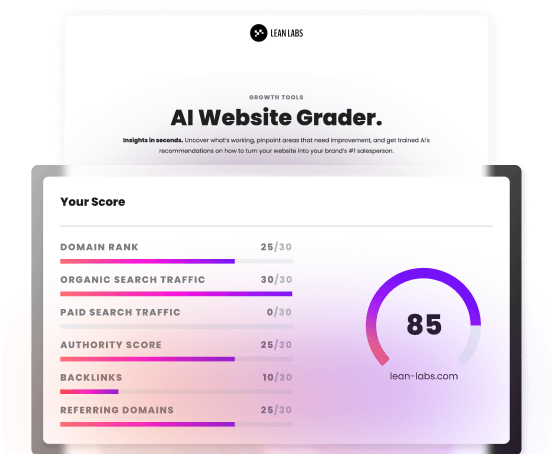
The detail to probe is engine coverage and recency. An audit that checks only one model gives you a skewed read, since the engines disagree with each other often, so look for coverage across several of ChatGPT, AI Overviews, Perplexity, Gemini, and Claude, plus a sense of how fresh the underlying data is. We point teams toward free starting points like HubSpot's AI Search Grader for a baseline read, and a paid service should clearly go deeper, with a competitor comparison and a prioritized gap list behind any headline sentiment score.
An audit only diagnoses, so treat a provider who stops at the audit as a partial fit. The value shows up when the audit sets the priority order for the schema and content work that follows, which means the right question to ask is what they do with the findings rather than only whether they can produce them.
Should an AI search optimization service own the technical work or just advise on it?
For most teams, a service that implements the technical work is a better fit than one that hands you a recommendations document, because schema and site structure are where a lot of the AI visibility lift actually comes from. Schema markup is the JSON-LD code that tells engines what a page is, what questions it answers, and how its entities relate, and getting it placed and maintained correctly is one of the higher-impact moves in the whole program.
Ask directly who writes and ships the structured data. A provider who owns it keeps the markup in sync with your content as pages change, while a provider who only advises leaves the implementation and the maintenance with your team, which works well if you have developers ready to act and tends to stall if you don't. On HubSpot, we built our schema markup for AEO to handle this at the platform level so the structured data is generated and maintained alongside the page as it ships, and the general principle holds whatever platform you're on: an approach tied to your CMS keeps markup accurate as content evolves.
The fit question here is about your internal capacity. If you have engineering bandwidth, an advisory service can be a clean fit and a lower cost. If you don't, a service that ships the technical work itself saves you from a recommendations file that never gets implemented.
What reporting should an AI search optimization service provide?
Strong AI search optimization reporting tracks brand mentions and citation share across multiple engines over time, which moves the focus past the keyword rankings a classic SEO report leans on. The measurement that matters is whether models name or quote you when someone asks a question in your space, how that compares to competitors, and whether it's trending up as the work lands.
Ask to see a real client report, redacted if needed, before you commit. The useful ones log the actual answers the engines give so you can read the wording and not just a sentiment score, they check several models on a recurring cadence so one model's quirk doesn't skew the picture, and they flag when a competitor starts winning a prompt you used to own. Because monitoring earns its cost only once you have content live to attribute changes to, a provider who insists on standing up heavy tracking before anything is published may be selling you a flat baseline, so reasonable sequencing is itself a sign of a service that has run real programs.
Reporting is also where you'll see whether a provider understands the lag in this work. AI engines update their reads on their own schedule, so honest reporting frames the first 60 to 90 days as baseline and direction, with citation share building once the structure and content are in place.
How do you check whether a provider gets real results?
The most direct way to check results is to search the AI engines yourself for the work a provider claims. Ask which clients or which of their own pages are getting cited, then open ChatGPT, Perplexity, or Google's AI Overviews and run the questions those pages target to see whether the named brand actually shows up as a source.
This check matters more here than in most categories because the work is so new that case studies are thin and easy to inflate. A provider who does the work well can usually point you to specific prompts where their content gets quoted, and you can verify that in a few minutes for yourself. When a provider can only describe results in general terms, that's a signal to ask for something you can test, not necessarily a reason to walk, since a newer team may have real skill and a short public track record. It also helps to look at a provider's documented client results to see what kind of outcomes they actually attach their name to.
We want a buyer to verify our work for themselves, which is why being able to hand someone a list of prompts to check is part of how we'd want to be evaluated too. Apply the same standard to every option on your shortlist.
How should AI search optimization services be priced?
AI search optimization services are usually priced as a monthly retainer or a scoped project, and the version that fits you depends on whether your need is ongoing or a one-time push. A retainer fits a program where content and monitoring run continuously, while a scoped project fits a defined push like an audit, a schema implementation, and a content overhaul with a clear finish line.
The number to focus on is less the rate and more whether success is defined up front. Ask what success looks like at 90 days and how it's measured, because a provider who can answer that in terms of citation share and named prompts has usually run real programs, while one who answers only in deliverables shipped is describing activity that may not connect to any result. Pricing in this category is still settling, so compare scopes more than headline numbers, since one provider's retainer may include the technical implementation that another bills separately.
Be realistic about the timeline you're funding. Because the engines update on their own cadence, the early months of any program buy you baseline, structure, and direction, and the citation movement follows once the content and schema are in place, which is worth confirming a provider will say out loud before you set your expectations against the invoice.
What questions should you ask before hiring an AI search optimization service?
A short list of questions surfaces fit faster than reading a pitch deck. Run these by any provider on your shortlist, including us:
- Which AI engines does your audit cover, and can I see a sample?
- Do you write and ship the schema yourselves, or hand me recommendations?
- What does a real client report look like, and what does it measure?
- Which specific prompts can I search right now to see your work cited?
- What does success look like at 90 days, and how is it measured?
- Is the technical implementation included in your fee or billed separately?
The answers tell you which layer a provider is strongest in, and that's the real decision, since the goal is matching a service to the gap your site has. A team that's strong on schema and lighter on reporting fits well when your structure is the weak point, and a team built around measurement fits better once your pages are already clean and you mainly need to track citation share.
Schema markup recommendations
Two schema types carry most of the weight for a buyer's guide like this one. Mark up the question-based sections with FAQPage schema so engines can pull individual question-and-answer pairs straight into AI responses, since each H2 here is written as a real query a buyer would type. Wrap the whole piece in Article schema with a clear author and publish date, because authorship and recency are signals AI systems weight when deciding which source to trust and cite.
Keep the criteria table as clean HTML rather than an image so engines can parse the rows as structured data, and validate every block with Google's Rich Results Test before you publish. Refresh the publish date whenever you update the guidance, since this category moves fast enough that an old date undercuts your credibility with both readers and the models reading on their behalf.
.png?width=1391&height=668&name=Growth%20Mapping%20Session%20(1).png)

.png?width=500&height=500&name=132%20(1).png)
.png?width=500&height=500&name=131%20(1).png)