.png?width=765&height=430&name=97%20(1).png)
.png?width=500&height=500&name=134%20(1).png)
Answer engine optimization trends B2B brands should adopt
The mechanics are consistent across most tools even though the branding varies. You give the grader your domain or brand name, it generates or pulls a set of category prompts that a real buyer might type, and it queries the models on your behalf. From those responses it builds a read on three things: presence (did you get mentioned at all), sentiment (was the mention positive, neutral, or off-base), and competitive position (who else came up and how often). That read becomes the score and the supporting detail.
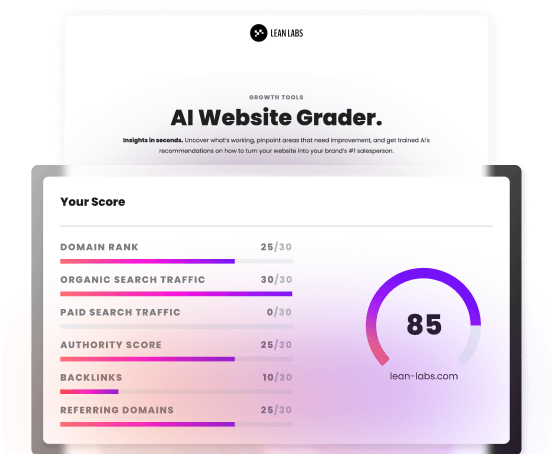
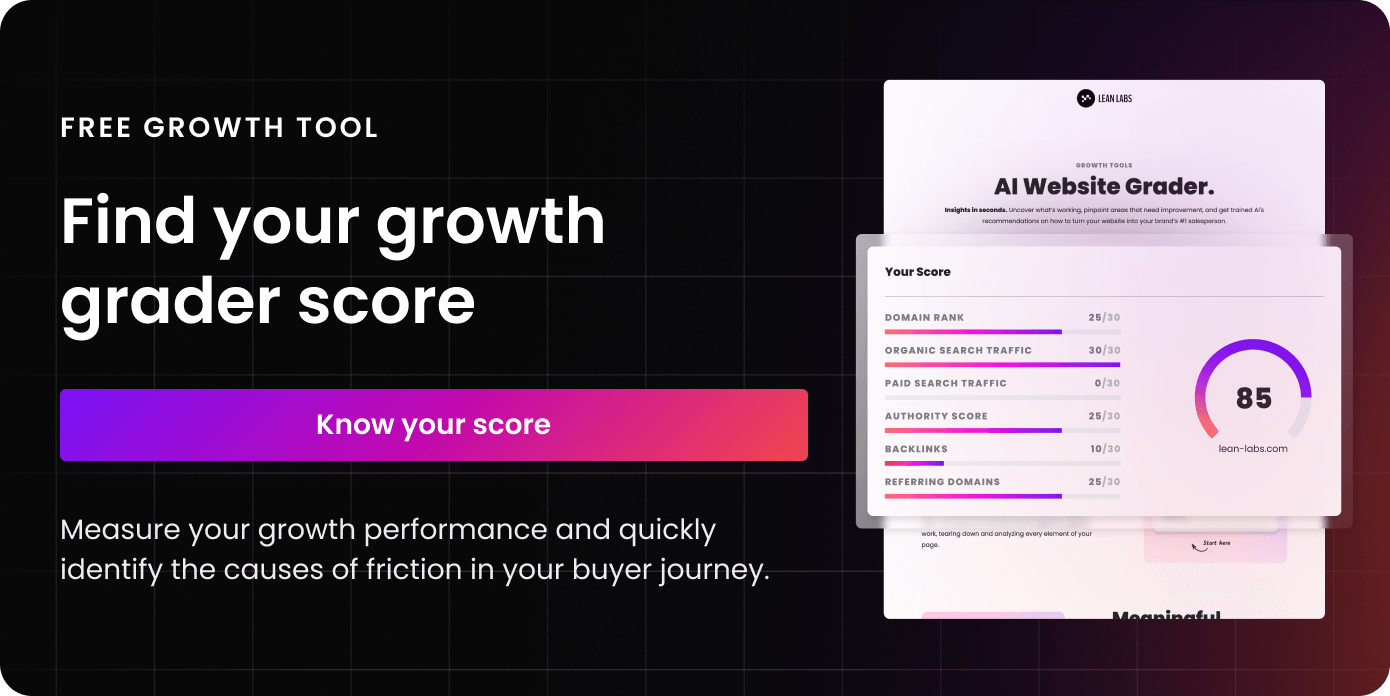
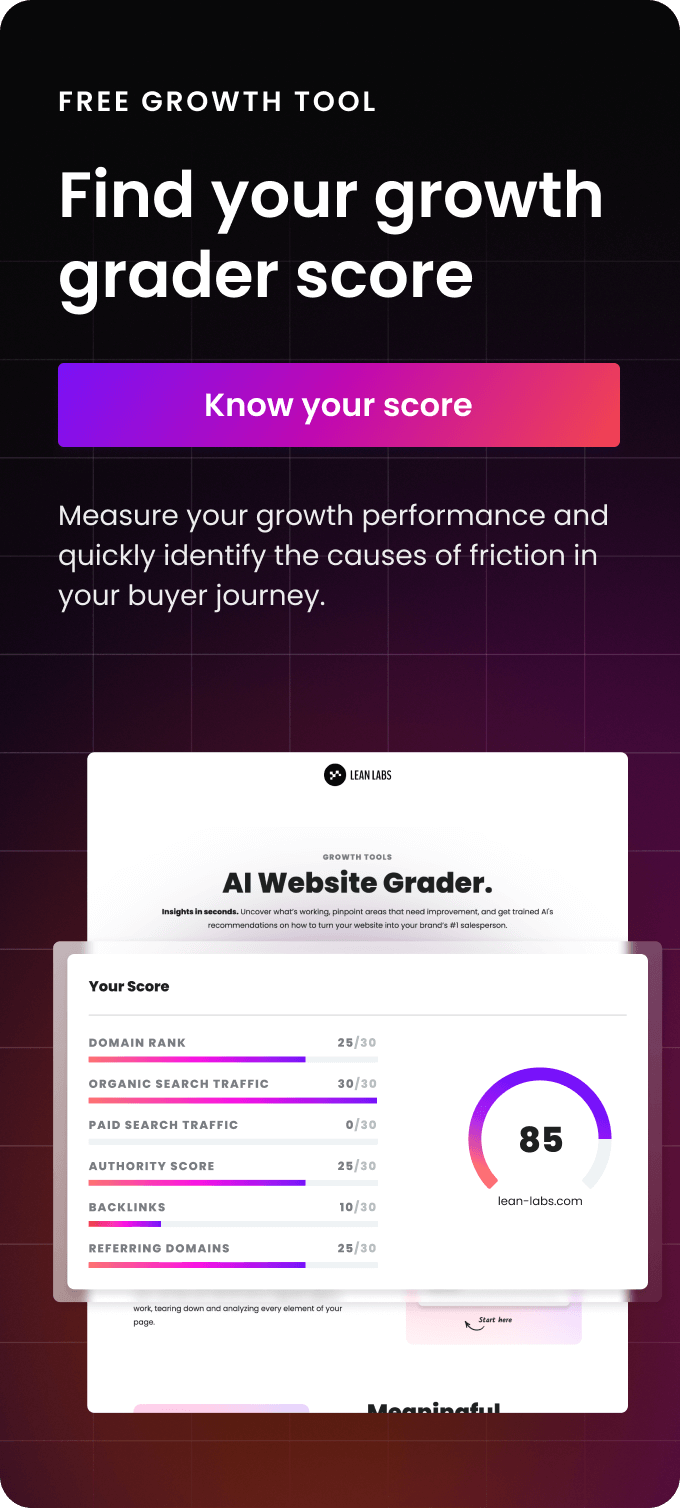
The reason this exists as its own category is that classic SEO tools were never built to measure it. A rank tracker can tell you where a blue link sits on a results page, but it can't tell you whether an AI quoted you as the source when it answered the question directly, so a different kind of tool grew up to read that layer. HubSpot's AI Search Grader is a well-known free example, and our own growth grader plays a similar role, though the category as a whole covers far more than any single product. There's a deeper walk-through of HubSpot's tool elsewhere in this hub.
VIDEO TRAINING
Get the Growth Playbook.
Learn to plan, budget, and accelerate growth with our exclusive video series. You’ll discover:
 The 5 phases of profitable growth
- 12 core assets all high-growth companies have
- Difference between mediocre marketing and meteoric campaigns
.png?width=798&height=842&name=Playbook%20(1).png)
Thanks for submitting the form!
What does an AEO grader actually measure?
An AEO grader measures four things in most implementations: whether AI engines mention your brand, how they describe you, which competitors show up alongside or instead of you, and which questions you're missing from entirely. Each of those readings points to a different kind of fix, which is why the breakdown underneath the headline score is the part worth studying.
Here's how those checks map to why they matter and what you do about each one.
|
What a grader checks |
Why it matters |
How to act on it |
|
Brand presence (are you mentioned at all) |
If the models never name you for category prompts, you're invisible at the exact moment buyers are deciding |
Build answer-first content on the questions you're absent from, so there's something for the engine to quote |
|
Sentiment and accuracy (what they say about you) |
A mention that's vague, dated, or wrong is its own problem, even when you do appear |
Publish clear, current, well-sourced pages that state the facts you want the model repeating |
|
Competitive position (who shows up instead) |
The names the model gives in your place tell you who owns the answer today |
Study what those competitors publish on the winning prompts, then cover the same ground with more useful detail |
|
Question coverage (which prompts you miss) |
The gap list is your content roadmap, ranked by the questions buyers actually ask AI |
Prioritize the prompts closest to a buying decision and write extractable answers for them first |
A grader reads all four at a single moment in time, which makes it a diagnostic instrument that captures where things stand rather than a tracker that follows them over time. It's a snapshot of where you stand today, and most of its value sits in what it tells you to go fix, with the headline number mattering far less than that punch list.
How do you read an AEO grader score?
Treat the score as a relative baseline, since the number only means something once you set it next to your competitors and your own past results. A grader that returns "62" tells you very little by itself, but "62 while your two closest competitors sit at 80 and 78" tells you exactly how much ground you have to cover and on which prompts you're losing it.
Three reads matter more than the headline number. The first is your competitive standing on the prompts that sit closest to a purchase, since being absent from a high-intent question costs more than being absent from a top-of-funnel one. The second is sentiment, because a model that describes you inaccurately calls for a very different fix from a model that has simply never heard of you, so it helps to know which situation you're in before you start writing. The third is the trend, which only appears once you've run the grader more than once, so we treat the first run as the baseline and every run after that as evidence the work is or isn't landing.
One caution worth keeping in mind: AI answers vary between runs even for the same prompt, because the models are probabilistic and their training data shifts. A single grader run is best read as one sample whose individual answers can mislead, which is why we look at the pattern across the whole prompt set instead of fixating on any one answer. When the same gap shows up across several related prompts, that's a signal you can trust.
What can't an AEO grader tell you?
An AEO grader can't tell you why a model describes you the way it does, and it can't fix anything on its own. It reports the symptom (you're absent from a prompt, or described poorly) without diagnosing the cause, which usually lives in your content, your structured data, or simply your absence from the conversation entirely. The interpretation is still your job.
A few limits are worth naming plainly so the score doesn't get over-read. Graders sample a moment in time, so they capture variance along with signal, and as a result can wobble between runs without anything real having changed. Coverage also differs by tool, since some query one engine and others query several, which means a strong score against one model can mask a weak showing on another. And because this category is young, products rebrand, reprice, and change their prompt methodology often, so the same tool can grade differently quarter to quarter for reasons that have nothing to do with your site.
None of that makes graders less useful. It just means a grader does the job of finding the gaps, and the work of closing them is content and schema work that sits downstream from the score. We treat the score as the thing that sets our priority order, then spend our actual effort on the pages it points us toward.


How should you act on your AEO grader results?
Turn the result into a ranked work list, starting with the high-intent prompts where you're absent or poorly described. The grader hands you a gap list; the move is to sort that list by how close each prompt sits to a buying decision, then work top-down so your effort lands first on the questions most likely to produce a customer.
The sequence we follow with clients is consistent. We start by writing answer-first content for the prompts where the models don't mention us at all, because you can't get quoted on a question you've never genuinely answered. From there we tighten the pages where the model mentions us but gets the description vague or dated, since a clearer, better-sourced page gives the engine something accurate to repeat. Alongside the content, we make sure the structured data is clean so engines can parse and attribute what we've published, and we re-run the grader on a regular cadence to confirm the citation share is actually climbing rather than assuming it is.
If you'd rather hand the whole loop to a team that already owns the stack, our answer engine optimization services cover the auditing, schema, and content work end to end. For teams running it in-house, the same principle applies whichever grader you choose: let the score set the priority order, then put your real hours into the content and structured data that close the gaps it surfaced.
Schema markup recommendations
Two schema types do most of the work for an explainer like this one. Mark up the question-based H2 sections with FAQPage schema so engines can pull each question-and-answer pair directly into an AI response, since every heading here is written as a real query someone would type into an assistant. Wrap the whole piece in Article schema with a clear author, datePublished, and dateModified, because authorship and recency are signals AI systems weigh when deciding which source to trust and cite, and a grader-related topic dates quickly enough that an accurate dateModified is worth maintaining.
Keep the comparison table as clean HTML <table> markup rather than an image, so engines can read the "what a grader checks" rows as structured data. If you publish schema across a HubSpot site and want it generated and maintained alongside your pages rather than hand-placed on each one, that's the job our machine-readable structured data module was built for. Whichever route you take, validate every block in Google's Rich Results Test before you publish, and confirm the visible content matches the markup so the structured data actually earns the citation.
.png?width=1391&height=668&name=Growth%20Mapping%20Session%20(1).png)

.png?width=500&height=500&name=132%20(1).png)
.png?width=500&height=500&name=131%20(1).png)