.png?width=500&height=500&name=126%20(1).png)
AI search engine optimization: the 2026 playbook
This happens regardless of industry, company size, or budget. A $50K build and a $150K build hit the same wall when the underlying approach is identical. Three patterns drive it:
Spending on design instead of messaging. Across 100+ builds, we've consistently found that messaging and buyer journey architecture drive roughly 80% of a website's performance. Custom design elements account for the remaining 20% or so. Most redesign budgets invert that ratio. You end up with a prettier version of copy that was already underperforming. Companies pour tens of thousands into homepage animations while recycling the same vague tagline they had three years ago.
Perfectionism blocking progress. The moment your new messaging and buyer journey are better than what's currently live, that version should be in front of real users generating real data. Every month spent polishing graphics is a month of feedback you didn't collect. The extra revisions rarely move the needle. The data would have.
Under-investing in strategy. Sometimes only a few hours go into messaging and competitive analysis, while nearly the entire budget goes to design. No customer interviews. No sales call analysis. No real understanding of what your buyer is thinking, feeling, or worried about when they land on your site.
By the time the site launches, the team's energy is spent on the build itself, leaving little bandwidth for the optimization that actually moves metrics. Two to three years later, another redesign conversation starts. That's the window where a different approach pays off.
VIDEO TRAINING
Get the Growth Playbook.
Learn to plan, budget, and accelerate growth with our exclusive video series. You’ll discover:
 The 5 phases of profitable growth
- 12 core assets all high-growth companies have
- Difference between mediocre marketing and meteoric campaigns
.png?width=798&height=842&name=Playbook%20(1).png)
Thanks for submitting the form!
AI Made the Same Mistakes Faster
Generative AI produces undifferentiated website copy by default. Companies started feeding brand details into tools and getting output back in hours. It looked clean and sounded professional, but it had zero differentiation from what any competitor could generate with the same prompt.
All AI knows is the patterns of the past. Hand it minimal context and it predicts outputs based on generic patterns. Average messaging by default. That's probably the worst positioning you could have, because now your site reads like everyone else's.
The companies getting strong results from AI in marketing all have one thing in common: they invested in setup. They trained the tools on real positioning and competitive differentiation. They fed in buyer objections pulled from actual sales call transcripts. In our experience, fewer than 5% of companies have actually done that work. The other 95% are generating undifferentiated noise at machine speed.
Give AI clean inputs and strong brand context, and it becomes a serious multiplier. Give it a logo and a tagline, and you get content that could belong to any company in your space. AI's capability isn't the bottleneck. Most companies just haven't given it enough context to produce anything differentiated.
How Growth-Driven Design Actually Works
GDD is a methodology for building and improving websites through continuous, data-informed iteration rather than a single large-scale launch. Instead of spending months building a "finished" site, you launch a focused starting point and improve it monthly based on real user behavior and performance data.
The framework runs in three phases.
Strategy comes first. You define the target buyer and map how they actually move from problem to purchase. Then competitive analysis and messaging architecture get built from that foundation. The raw material is customer interviews, sales call recordings, support ticket themes, and competitive research.
The whole phase comes down to four questions: What is the buyer's biggest problem? What have they already tried, and why did it fail? What needs to change in how they think about the problem? How does your solution make that change easy, and where is the proof?
Most companies skip this phase or compress it into a few hours. We spend three to five weeks here, depending on complexity. That time is what separates a site that performs from one that just looks good.
The launchpad is the build phase. You scope down to the three to eight pages that actually drive performance. On a 50-page website, roughly 10 pages do all the meaningful work. The launchpad focuses budget and effort on those pages, with a two-to-four-step buyer journey for each core solution.
A launchpad is not an ugly site. It's a strategically narrowed site that prioritizes messaging and conversion paths over ultra-custom design components that eat revision cycles. Timeline: a four-week messaging sprint, a four-week design sprint, and a four-week development and launch sprint. We guarantee delivery within 12 weeks, and GDD projects often finish in eight to ten.
Continuous improvement runs after launch. Monthly sprints identify the highest-traffic pages with the worst-performing metrics, prioritize changes using the ICE method (Impact, Confidence, Ease), implement modifications, and measure results for statistical significance. We offer this as a fractional service at roughly $5,000 per month.
We have clients who have been on the same website for more than seven years because they run GDD consistently. The pages never become outdated, the messaging stays sharp, and conversion rates keep climbing. The full ground-up rebuild becomes unnecessary, which means you stop paying the re-platform tax every three to four years.
Bounce Rate, Exit Rate, Conversion Rate: The Only Three Metrics That Matter First
When someone tells us their website isn't working, we look at three things before touching any design files.
Bounce rate on key entrance pages. If it's high, the messaging isn't landing. The visitor arrived, read what was there, and left. That's a messaging problem, not a design problem.
Exit rate on key pages. If it's high, the next steps aren't working. The visitor engaged with the page but didn't find a compelling reason to continue. That's a buyer journey problem.
Conversion rate on offer pages. If it's low, you have both a messaging problem and an offer problem. The page isn't building enough trust, or the ask doesn't match what the visitor is ready to give.
Fix these three and you move the needle more than any level of design polish or visual refresh. The math works like this: if you cut the exit rate on key pages by 50%, you deliver twice as many visitors to your conversion pages. That alone is a 2x improvement. Then if you double the conversion rate on those pages through better messaging and stronger offers, you get a 4x total increase in leads.
That's how 100% to 300% conversion rate improvements actually happen. You're not just improving individual page conversion. You're improving the number of people who make it to conversion-ready pages in the first place.
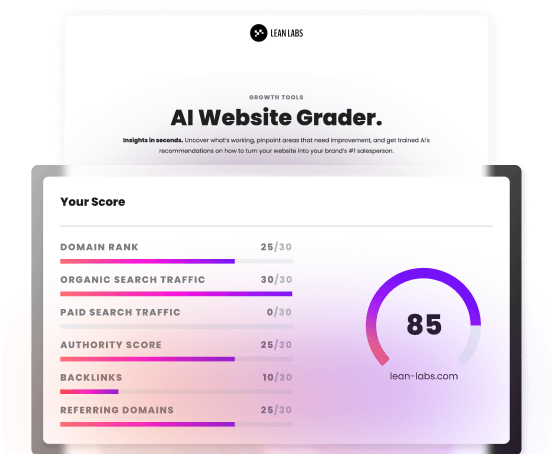
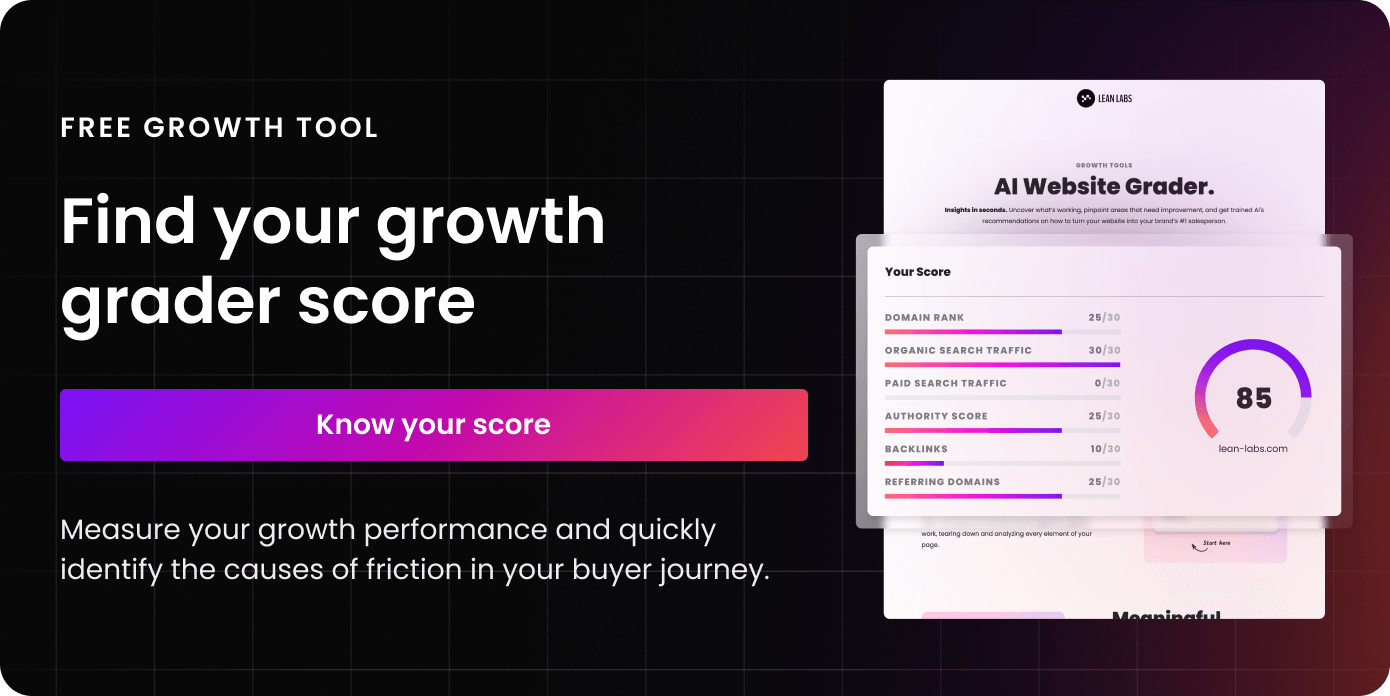
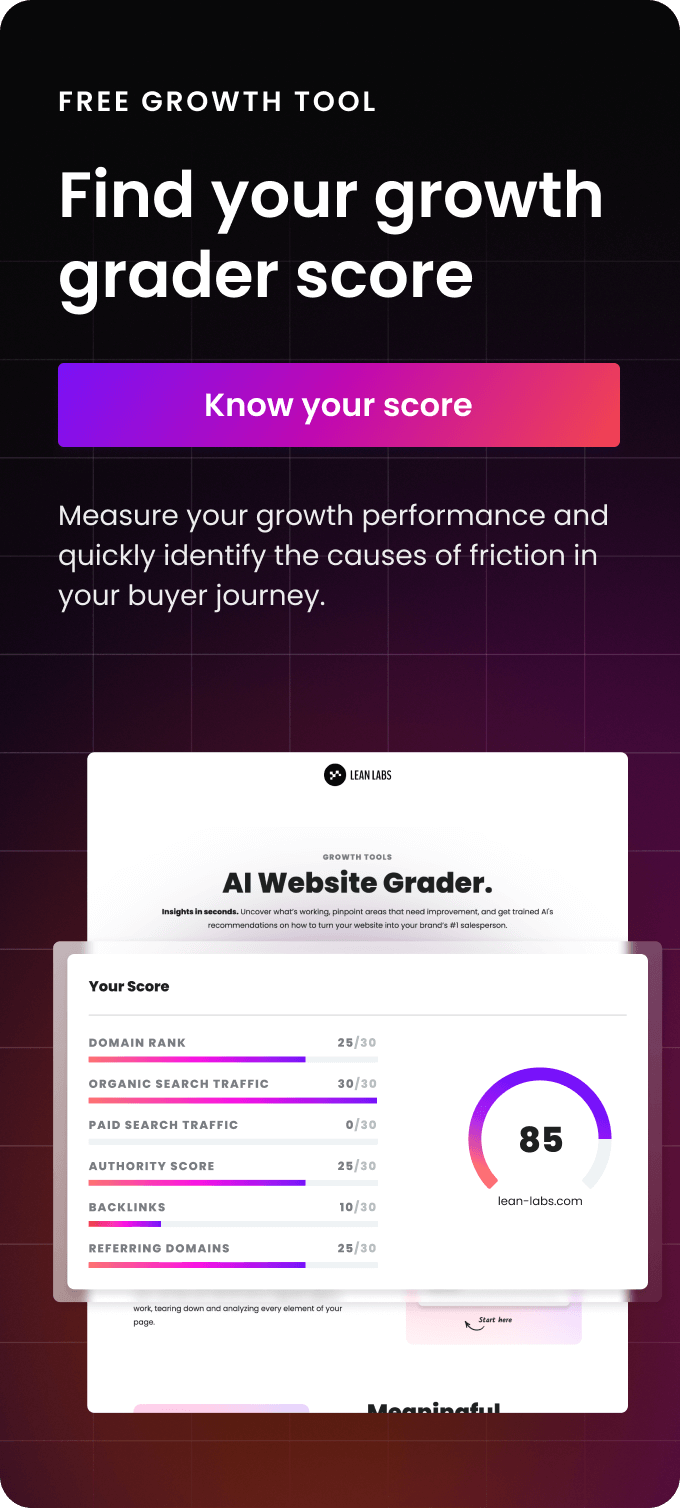
We run all new projects through our diagnostic tool at growthgrader.com before any design or development work begins.
Your Site Probably Only Works for Hot Buyers
Most websites are built for one type of visitor: the person who already knows you, likes you, and is ready to buy. That's your hot buyer. Their journey is simple and most sites handle it well enough.
The problem is that hot buyers are the minority of your traffic. The majority are warm (open to considering you if you give them a reason) or cold (haven't even convinced themselves they need to change their current approach).
GDD structures your site around all three temperatures.
Cold pages address problem awareness. They help visitors recognize that the way they're currently handling something isn't working as well as it could. No pitch. No product features. Just a clear articulation of the problem they're already feeling, stated in their own language.
Warm pages differentiate. They show your specific method of solving the problem and why it's different from what the visitor has already tried. If you can't explain why you're different, the buyer assumes you're the same as everyone else.
Hot pages close the gap to sales. They walk through your specific offering with proof points backing every claim. Testimonials, case studies, specific numbers, process details. If you spent twice as much time on proof as you spent on graphics, your engagement and conversion would improve dramatically.
The architecture moves visitors from cold to warm to hot, then into a sales conversation. Each page type has proven page flows refined across hundreds of builds.
AI Inside GDD Works. AI Instead of GDD Doesn't.
AI is genuinely useful inside a GDD process. Our tools are built around it, and we use them daily.
Research agents scrape competitor sites, analyze SERP results, pull AEO (Answer Engine Optimization) data, and compile competitive intelligence faster than any human researcher. We run these in the background while working on other projects. The accuracy on pure scraping-and-reporting tasks is high.
Drafting from strong inputs is where AI earns its keep. When you've done the strategy work and have solid positioning, buyer insights, and messaging architecture documented, AI can produce drafts that need polishing rather than rewriting. Output quality directly tracks input quality. MessageRocket is built around this principle.
Testing velocity jumps significantly. AI makes it faster to generate headline variants, CTA copy alternatives, and messaging tests for split testing. What used to take a copywriter a full day takes minutes. That means you can test more frequently within sprint cycles, which means you learn faster.
AEO and structured content is a natural fit. Structuring your website for AI citation requires semantic chunks, machine-readable markup, and question-based content architecture. Schema Rocket handles this, and it plugs directly into the GDD workflow on HubSpot.
Where AI falls short: it can't tell you why you're different. It can only remix patterns from content it's already seen. Your competitive positioning has to come from human judgment, sales insights, and market understanding. Then you train AI on that positioning. AI also can't replace the feedback loop. It can generate a website in a day. It cannot tell you whether that website is going to convert. Only real traffic, real behavior data, and real iteration answer that question.
.png?width=2146&height=1250&name=july-16-cta%20(1).png)

What This Costs and How Long It Takes
We used to run GDD as a $12,000-per-month engagement. That's changed. Our tools now put more capability directly in your hands, which compresses both cost and timeline.
|
Phase |
Timeline |
Investment |
|---|---|---|
|
Messaging sprint (using MessageRocket) |
3-5 weeks |
Starting at $3,000 for the tool; $9,000-$12,000 for packages including consulting |
|
Design blueprint |
4 weeks |
$9,000-$12,000 depending on tier (Improve, Impress, or Inspire) |
|
Development on HubSpot (using Sprocket Rocket) |
4-6 weeks |
$10,000-$25,000 depending on scope |
|
Ongoing GDD sprints |
Monthly |
~$5,000/month fractional |
Total launchpad investment typically lands between $22,000 and $49,000. That's about half what a traditional custom-coded website costs, with significantly better performance outcomes because the messaging and buyer journey work is actually done first.
The 12-week guarantee matters. Traditional redesigns drag to four or five months routinely. That delay costs more than people realize, because every month your underperforming site stays live is a month of lost conversions you can't get back.
For smaller companies, GDD sprints can run on an intermittent schedule: three months active, then three to six months on pause while experiments validate. Then you come back with fresh data for another targeted round.
Your Website Also Needs to Work for AI
Answer Engine Optimization (AEO) structures your content so AI systems like Gemini, ChatGPT, Perplexity, and Claude can parse it, understand your brand, and cite you in their responses. This isn't a future concern. It's happening now.
Unlike traditional SEO, which rewards long-form pages, AEO focuses on semantic chunks that answer specific questions in bite-sized, machine-readable components. The structural alignment with GDD is almost perfect. The same principles that make a site convert well for humans (clear messaging, standalone paragraphs that answer specific questions, structured data, proof points) also make it readable and citable for AI.
An over-investment in fancy graphics with thin copy hurts you in both dimensions. AI literally cannot parse your animated hero section. It can parse a well-structured paragraph that clearly states what you do, who you serve, and what results you produce.
We build AEO into every GDD engagement through three components: an answer hub with structured Q&A content, Schema Rocket for JSON-LD markup, and an off-site consensus strategy. The difference between getting cited by an AI answer engine and being left out entirely often comes down to whether your content is structured for ingestion or buried in design-heavy page layouts.
How GDD Satisfies Your C-Suite Too
A common concern we hear: "My CEO wants a finished website, not a launchpad."
GDD isn't about asking your leadership to accept less. Every engagement includes what we call grease points and polish points. Grease points are functional improvements that drive metric improvement. Polish points are the visual and brand wins that make stakeholders proud. Both are built into the plan. The sequence is grease first, polish second, because the performance gains fund the refinement work.
Your C-suite doesn't lose because you're taking a buyer-first approach. They get a site that actually performs, and then they get the visual polish on top of a proven messaging foundation. That's a stronger outcome than launching a visually stunning site with flat metrics and no budget left to fix it.
The readiness signal for GDD is simple: you're willing to look at the metrics and let performance data drive decisions, with a single decision-maker and one or two subject-matter experts providing input. The warning sign is when a team wants to make decisions by committee. Committee decisions are what start the spiral into over-budget, over-time projects that forget the user they're serving.
We back the Design Blueprint phase with our No Yay, No Pay guarantee. If you're not happy within the first three weeks, 100% refund. The only people taking risks are us.
What to Do Next
If your current website isn't converting the way you expected, start with the diagnostics. Look at your bounce rates, exit rates, and conversion rates on your top 10 pages. That will tell you whether you have a messaging problem, a buyer journey problem, an offer problem, or some combination of all three.
If you want us to run that diagnostic, we'll do it through growthgrader.com and walk you through what we find. No commitment required.
From there, the path is clear. Fix the messaging. Build the buyer journey. Launch. Measure. Improve. Repeat. AI makes every step faster, but it doesn't replace any of them.
We've been running this process for over a decade across 100+ HubSpot builds with zero failed projects. Our results page has the specifics, including the 271% conversion rate increase for Integrate and 740% organic growth results. The approach works for SaaS, professional services, and enterprise teams that need to move faster than their current process allows.
The best time to start GDD is before your next redesign. The second-best time is instead of it.
.png?width=1391&height=668&name=Growth%20Mapping%20Session%20(1).png)

.png?width=500&height=500&name=120%20(1).png)
.png?width=500&height=500&name=122%20(1).png)